
This is going to get heated, but we, as a community, MUST address this RIGHT NOW.
“Is it ever okay to copy your competitors?”
Before you share your thoughts in the comments, let me set the stage…
The Two Types Of Copying
There are two types of copying. One is just smart business, and the other is just straight up stupid. Let’s talk about ’em both.
When Copying Is Good For Business
There are two specific scenarios where I believe copying your competitors is one of the smartest business moves you can make.
#1 The Drafting Technique
A few months ago I revealed what I call the drafting technique. For those of you who are unfamiliar with it, here’s the short of it:
When you’re looking to score major media, whether you’re trying to get in the newspaper or on a huge blog, the best way to do it is by “drafting” behind your competitors.
What’s drafting? Figure out where your competitors have been featured, and find the hook that allows you to get featured too.
For example, as Pinterest was on the rise, I was talking to the guys over at Gentlemint (the pinterest for men) and I told them that they should reach out to every newspaper reporter that covers Pinterest and pitch Gentlemint for men as a potential follow-up article.
Pinterest was hot, and this was a simple and easy for for Gentlemint to land major media with journalists simply because journalists LOVE stories just like that.
#2 Make Something Better
The other type of copying is less about copying, and more about improving what already exists.
As an example, A Malcolm Gladwell article referred to Steve Jobs as a “Tweaker.”
The reality was, Steve Jobs didn’t invent anything. Instead, he simply found what existed, and made it much better and more user friendly.
To me, this is completely okay.
Improving what exists is a proven way to make a splash within a community. It’s also a great way to build a remarkable and sustainable business that people LOVE.
But There’s A Time When Copying Is Dumb…
…And earlier today, I stumbled on a PERFECT example of it.
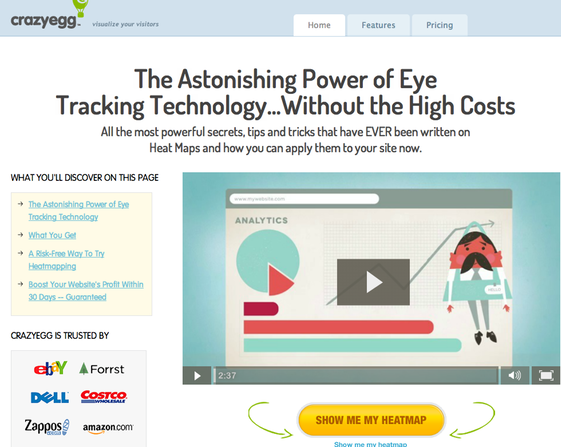
Take a look at these two screenshots:
Screenshot #1: Crazy Egg (a heat mapping service that I’ve recommended in the past)
Screenshot #2: Click Tale (a competing heat mapping service)
Update: Clicktale has since remove this page from their website. They’re still one of my favorite services for heat mapping software, and I’m glad they chose to do the right thing.
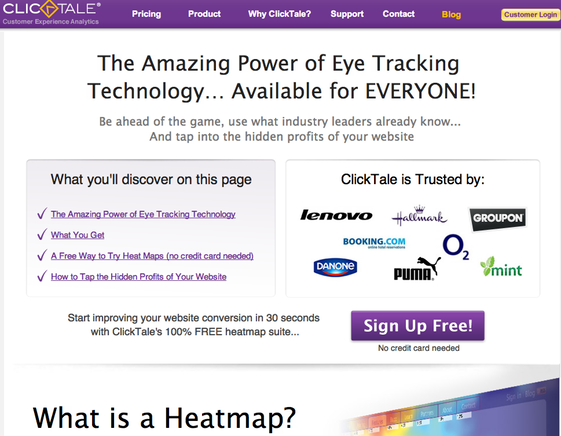
The design… the copy… the Johnson box… EVERYTHING… appears to be an exact replica.
(For those of you wondering, a Johnson box is that little “What you’ll discover on this page” box).
And based on Neil Patel’s (one of the founders of Crazy Egg) latest tweet, it appears Clicktale copied Crazy Egg.
To me, if Clicktale really did copy Crazy Egg, that’s the dumbest they could have done.
Even if Crazy Egg’s design converts brass into gold… copying it word-for-word is stupid for two reasons:
First, people WILL find out. And when they do, articles like this one will be published
(Plus, if you’re a heat mapping company, why are you copying a rival’s website? Shouldn’t your software allow you to create your own innovative designs?)
Second, it’s just the WRONG thing to do. There’s no way that anyone can justify this as “morally okay in my book.”
But Now I Want To Pass This To You…
When is it okay for a company to copy their competitors?
Be as specific as possible, and if you’ve ever been ripped off by a competitor, share your story in the comments
(One note: Please refrain from mentioning specific company names. Keep it to the story and the industry you’re involved in)
Also, I’d like to get as many stories as possible, so if you can please share this on Twitter, it would be great.
“When is it okay to copy your competitors?” – Click to Tweet







There is a local company that has continually mimicked my ads to the point where they are literally taking my photos that I spent time custom making and simply duplicating them. You can even see our watermark text in the pictures. Then today I see that they copied another ad and this time they used everything I wrote word for word. To the point where you can clearly see all the heartfelt words used by me personally for years in how I speak to consumers. It is sickening.
The problem is that they have done some pretty awful things to me personally and I am stuck in a hard spot because I fear they will do whatever it takes to get dirty and attack me if I complain or take action. I want this to stop so bad because I am sick and tired of people confusing me for them! I have had people that feared doing business with me because they thought I was them hiding under another name because our ads looked the same.
So I have a former landlord, who persistently pleaded with me to have him as a partner in my business. But after several attempts with no success, has decided to open a similar burger joint with all similar recipes in New Jersey. He took some of my employees, who gave him my recipes, that I worked so hard to create for many months. He is about to open the burger joint sometime this month, today, he posted a photo of one of his burgers on his website, and it is exactly the same as my burgers. His menu, and almost all the items on them are exactly the same as mine, except that he has different names for the burgers. I feel like I have been ripped off, and I do not know how to go about this.
Hi I have been reading with interests the stories on copying contents from your website.
Still I am surprised how others get away with it:
I am a company based in Turkey in a small village of Uzumlu. I run along with my partner a construction, estate agency business. Our company has been going since 1998 with no issues. Until I discovered my pure accident, a local English man in our village has copied our website, even down to the logo. Our company is call villahomesturkey.com. our company colours are red and blue. our logo is a square split in two one side red one side blue. Its very distinctive and very well know in the area.
His recent link to a website selling houses, rentals and car hire is called villahomesturkey.co.uk. same logo, same colours and same text. he even wrote on the bottom of the link: We are for defendantly not associated with a similar website of a estate agency in Uzumlu.
This is just not acceptable, I have now closed our website and feel the only way to sort this is to completely change our face. But this has angered me, that though I have asked forums and even google can they enforce a shutdown on this link.
We have been successful for all these years and are very much use to competitors, but this really take the biscuit, that a person not legally able to work in this country, who lives in the same village, can set up a web link using my company’s Logo, text and colours and get away with it..
I feel I have no choice but to shut down and build a bigger and better site, which of course is costing me funds. However I then beg the question, what happens if it happens again?
Can I do anything to shut down this link?
Look forward to any help or advice on my issue and story.
Julia Winman
Villa Homes Turkey
i have a lock on my boat that broke because the guts are cheap material i remade said part with better material and improved the design can i resale this part to consumers as my own part or is that illegal
We’re a parenting magazine dedicated to “bringing back the village.”
We hold events call Gather.
We’ve had Gather The Village which are events for mothers to gather together, and Gather The Makers, gathering business entrepreneurs.
Now a bigger event company is ripping of our Gather idea. Our slogan is “Gather the Village.” They liked all of our social media pictures, are starting an event called “Gather” with the same type face, and changed their hashtag to #bring on the village.
What do we do. They are starting something so similar to us.
I do marketing for the automotive industry. Every promotion I put out is something my team and I painstakingly come up with, and every time, they are copied, nearly, if not exactly, word for word by our direct competitor. It’s gotten to the point where I want to IP block them from our website. I do not know if what they are doing is legally, or just morally black, but it is quite annoying. Why can’t they come up with their own ideas, instead of stopping as low as stealing ours?
So, my martial arts gym recently updated their website complete with sub-sections and quoted testimonials with pics.
Problem I noticed was none of these photos or supposed members were in fact members. I googled one name out of the bunch and soon found no less than 27 other martial arts gyms with the exact same web design, word for word, pic for pic and testimonial quote for testimonial quote. It appears all of these businesses turned to the same marketing company to design and market their gyms.
This upsets me quite a bit to see this. Is this even legal? If so, at the least it feels very unethical. Worst part is, we have great members who would gladly give real stories and real quotes.
A company which is franchised, has a process that is claimed by them to be copyrighted. They offer a customer a discount, a few services of value, in exchange for a monthly service fee. They offer a good, better, best approach, I am offering a basic, advance, and premier approach. they offered a 15% discount, I offered a 10%, but I offered a few additional services for the same amount of money…am I violated copyright law? I had my offer on my website, but pulled it however, I want to market it because it is smart business. Go Daddy does it, Insurance companies do it, many businesses do it, I just want to know more about it, but can’t find anything in caselaw, statute, etc…to define my situation, it is now all about digital.
As a freelance graphic designer it can be difficult to not be inspired by another designer’s work, but I can agree that an exact rip off can be damaging. Sometimes it’s more about the spirit in which it was done and the honesty of the persons involved.
Hi please get me out of this problem me and my friends started developing an app which is about music but we found the similar app which is very popular in another country and has many users it is not very much famous in my country, the concept of that app and ours is 70% similar so shall we continue our app with some differentiating feature please suggest us
What is it called when a co worker takes your email and changes the subject, a couple of dates changed, but the body of the email remains your writing and they send the email as their own? Are there professional ethics to address this type of copying?
Thank you.
Author Richard Evans said everyone is guilty of plagiarism for there are no original ideas. Meaning we are the product of everything we have read, heard or seen. He is correct. Hence, we speak as though our concepts are original when they are not. Most aren’t even polished. Everyone here can have their ideas tracked back to something or someone heard in a lecture or conversation. A tweaked comment from a book.
I have a problem that may be related to this post. I am hoping someone can offer advice or direct me to a post that deals with problems of this nature. In 2002 I created a website that combines travel journals, culture, original music, photos and videos and have constantly updated it since. Recently someone has flooded social media sites (Facebook, Soundcloud, Wix, Twitter, Youtube, ITunes, and has a .org site using the same name and providing original music, jounals, cuture, photos and videos. I am currently researching trademark and copyright infringements, but none of these laws seem to adequately address this particular problem. The name is trademarked under common law. Yet this person has obviously copied the model (which to my knowledge was the first of its kind on the web ) It seems, though I am not certain, that I can contest the name under trade mark but cannot contest the copying of the model, even though it is an exact duplicate of name and model together. Any suggestions?
What a great post and what great comments following.
As far as it was my experience since now, I cannot but confirm that in case of trusted Sites with an already established history, the fact to have been “attacked” by a small % of spammy links is not affecting the overall rankings and seems that Google is quite able to detect them as an anomaly, as if it were assuming is something that will be corrected in the future.
But things can be different in case the % of the spammy links is getting higher, closer or above the 50% of the link profile of a website.
That can explain also the theory that the bigger the link profile is the hardest a spammy link attack can sink a website, and – on the contrary – that if the link profile is small, therefore is easier that the website suffering the attack can be penalized.
What to do?
Obviously to ask for a Google revision is the start, then the suggestion to ask to the Hosting Company and the Registries (and why not ICANN itself if the case is really an harsh one) to act in your defence can be useful. And, obviously, clean the code (if the attack is from both sides > hacking and link spamming), counter attack with a large scale white hat link campaign using especially viral content.
About what said by Conner, I think that sometimes we confuse Great Content with Great Number of Links. The two are no so connected. What connects them is our job… link building (with every legit tactic) spreading the news of the existence of that great content is there in our site.
The most important is to follow the basic of link building:
links from multiple sources (aka: domains)
variated link profile (not just from our specific theme, even though it’s logical that links from same theme website will be in a bigger %)
natural anchor text policy
no sudden adquisition of 100s of links in a very short frame of time, or if it happens due to some viral tactic of the moment, pay attention to the anchor text.
You know, Derek, you really opened up a can of worms here.
I’d expect that this issue may be well-defined from a legal perspective, but from a moral standpoint it seems quite gray to me.
Here’s my example:
I work in a small, hi-tech niche, so we pretty much have just two main competitors. I’d say I probably browse through our competitors’ websites every few weeks, to see what we can improve. I feel like it’s always best to stay ahead of the competition, but at the very least I want to be sure we aren’t falling behind.
The other day, I noticed that one of the site’s pages had a parallel on our site, but they used bigger, more noticeable images.
Okay copying: we should also use images
Not okay: exact same layout
But the question is where to draw the line. The above example shows both extremes, but I think it isn’t so easy to find the middle ground where it changes from legitimate idea-inspiration to downright copy/paste.
Love to hear what you think,
Effy
PS – Great post!
Thank you for sharing this great post! Do you want to know more game news and game skills? If you do, can visit my blog, you can find the same interested friends with you.
Call me silly, but the only thing I see about this website is the phrase “Power of Eye Tracking Technology..” and I know copyright laws do not copyright the alphabet, or “copy” as most marketers call it.
There are thousands of websites out there and they all look the same to me but with a different design/layout. I don’t see the difference between the two, they’re not copied to a T.
Will someone please point it out to me as to where the “copying” actually took place between the two companies?
NO. I dont think Click Tale Copied Crazy Egg. Matter of Fact I think Click Tale Made the presentation better.
Samuel, I agree with you – not my comment above. I have a strong feeling that it is just the other way, that Crazy Egg copied ClickTale, but they didn’t do as good a job.
This article came just in time. I have a question about copyright and intellectual property that maybe yourself, or your audience, maybe able to shed some light on. So…you are putting your business website together…you have nearly 5 written pages of ideas…colours, fonts, strict direction on layout, i.e. that you have sent to the developer, and you are very much involved with the overall look and feel of your sight, down to the margin widths.!
In fact, it would be fair to say the only thing your not involved in is the creation of the psd files – because you lack the skills.
You work with a web developer to bring your idea to life, but for one reason or another the working relationship breaks down and you decide not to move ahead with the coding/development stage, but, you have a design you love. It’s exactly what you wanted, and a result of weaks spent working with the designer. At the end of this process, who owns the design? The look feel, layout etc…especially if this wasn’t some great innovation of the designer but a result of your imput in every area?
This question is quite personal to be as you can probably tell, but I’ve been stuck with this for a while now, as I want to go ahead and develop what I believe is my design…however the last thing I need is to get into a dispute with the designer – or worse have my site taken down no questions asked. I know some will say, just get a new design…which would be fine, expect the one I have now is perfect, and exactly what I wanted…and any new design is only going to be a rehash of the old ideas Ialready had. This situation is costing me time, money and grey hair, and your advice on where I and others would stand is a situation like this is much appreciated.
While I can’t speak for all design firms, your question generally falls under the “work for hire” category. Check your contract (if you signed one) and ensure that your company will retain ownership of the final design. For the purposes of my firm, once a client pays in full, they own the design. That is, after all, why they hired us.
It is okay period, with the exception of copy writes, trademarks etc. Using a competitors idea is part of competing.
In the retail industry, market leaders who were developed after some of there competitors were able to utilize something a competitor was doing, build on it and exploit it to their advantage.
One example I will use is a companies loyalty card which you may carry on your key chain. Most likely many people have more than just one. The average person has their favorite store’s loyalty card and the competitor of that company’s card also.
Both company’s didn’t start giving out loyalty cards on the same day. One went first, the other saw the value and success their competitor was having so they jumped on board instead of getting left behind.
The same can be said about retail store competitors who have websites. One went first, the competition then followed suite. Why? Because their was money online to be made and if they don’t copy they will lose market share quickly.
I like how you played with the words here Derek :). I don’t consider it copying unless it is literally copied. Original ideas don’t exist all we have no are ideas built upon ideas. I think it is perfectly okay, to take what other people create and then make something utilizing that and then make it better.
The problem arises when we are unwilling to make things our own. I think it is also important to give credit, where credit is due. Hands down! If someone has had a huge impact on me or a product I create it is only right if I let the world know this.
I guess for me it is simple. If I can honestly look at what I have created and can say “this is now better” then I do think it is okay. Integrity can sometimes be grey… But often we know in our gut whether it is right or not.
This is an interesting topic and one I run into constantly as an owner of a small media company. While we try very hard ( to the point of outright leaving clients) to keep our clients from copying web content, it is often difficult. While we explicitly tell our clients that it is unmoral, unethical and in many cases outright illegal to copy web content, many of them do anyway. We have come to understand that many of clients do these things because it is simply more efficient (in their mind) to use “ready made” content rather that go through the exercise of truly trying to under their business and their industry.
To answer the question posed, we often find that copying general ideas is useful while copying specifics isn’t. Many times it comes out on a case by case basis. As mentioned earlier in this blog, it does absolutely no good to copy a direct competitor as the whole point is to create differentiation. That being said, often times we run into layouts, frameworks, trending topics and other elements that we can put our own spin on. In these cases we prefer to think of it as a value add rather than plagerism. Ultimately, our litmus test is this: “By using these elements, will the average consumer confuse us with our source.”
Like it or not, copying is rife on the internet.
TBH I still don’t know where I stand on people copying my content – for a long time I had a plugin called blog protector which disables right click & copy/paste when people browse your site – I then went the other way and installed a plugin called TYNT which actually allows people to copy you and adds a link to your site (more backlinks if they don’t delete it) – the theory being that some people may be copying to share for genuine reasons.
As I said, I still don’t know where I stand.
I think in general it’s OK to copy ideas and to make them your own by adding to those ideas or translating them in your own words.
Some reputable people on the internet told me if you don’t know what to write – check the post headings of your favorite blogs – don’t actually read the post, but just write your version of the post that would have that heading (I suppose you could then also change the heading later – so in the end 100% original content, no copying at all). Though I thought this sounded like an awesome idea, I’ve never actually done this as I don’t run out of things I want to write about.
Your content is great Derek, have you ever thought about protecting it?
I suppose perhaps a small site with great content has to worry more than a big site with great content (as in the latter case the masses will be more aware of where it was first published), just a thought…
See Steal Like an Artist by Austin Kleon. He lays this topic out eloquently and with pictures 🙂
Usually those original content, due indeed go viral. There are times that plagiarism are noticed throughout sites… but reputable sites really refrain from this approach.
Most of my livelihood comes from the offline world. I own an insurance agency. We sell life, auto, home and health (mostly). Since we aren’t supposed to mention companies I won’t. But let one company have an oogling of success with an idea and guess what happens?
I don’t think this issue is limited to us small time (compared to the giant corps) marketers. It is done everyday and they actually have people evaluating other companies. They call it research, ha ha.
Anyway, good topic and just thought I’d toss out my real life experience from behind a desk.
Much success to all.
I feel bad calling this girl out, but her design is Marie’s exact design (www.marieforleo.com) , and her voice/copy are sooooo similar it’s scary. I’m assuming she was just starting out and was looking for direction, but it’s a little to close for comfort I think…
WOW! blatant!
Although, I wonder if she’s one of Marie’s students…
This may touch back on Derek’s comments about mastermind groups — but I have noticed a lot of people in the that are B-school grads or who just read marie’s blog who (on some level or another ) copy her essence.
Either in your example, where it looks like they download wp-marie-forleo-theme, or in a less direct way of the informal, care-free persona that is reminiscent of Sex in the City.
My issue with this is that Marie is wildly successful and good at what she does… which means she has First Mover Advantage… She has a lot of great advice and it’s probably a good idea to use her as an example or template, but here’s the problem: There is only one of her. Anybody who copies (or rips-off) will always come across as “oh, it’s generic marie forleo” – It’s like asking for a Coke and getting Sam’s Choice Cola… not the same.
Overdoing the copying is like automatically killing your biz model – relegating it to “generic” status.
Hi Alex,
I’m addressing your comments above regarding my blatantly copied web site…and am once again stepping in to defend myself against this person who is making a point of trashing me for some reason everywhere she goes. Yes I know who she is, sadly a fellow B-Schooler. When someone makes this much of a point of trashing someone else, there’s a little more involved. I’m praying for her. 🙂
First off, I asked for a Thesis themed web site with the Marketer’s Delight skin using the same layout as Marie’s and several other web sites that are laid out EXACTLY like hers (some before hers). I wanted a Sex and the City feel to it – a carefree, fun, girly, yet empowered theme – which fits the voice of my business. Some of my web copy was written several months before I found Marie or her videos.
I have reached out on my own to Marie’s people about my site. My designer has made and continues to make revisions to make it more my own. All of the fonts, colors, code, copy and programs are 100% mine. Also, I’m not a competitor of hers in any way.
Was this a lack of imagination? Yes, but that’s all. There was never any mal intent. And as my business evolves, my site will as well. I’ve had four web sites built in the past and one of them was used as a template for a business owner in a different industry. I had no issue with this whatsoever and was actually pretty flattered by it as I had created it on my own.
Now, on to doing something more important than defending myself – helping lift other women up, not tear them down.
The point of the comments wasn’t to call out specific people for copying. I don’t like the overall negative tone of it all.
And while I see some similarities in the design, usually stuff like that is better reserved for private conversations :-).
Derek – If I added to a negative tone, please forgive me. It was not my intent.
Alison – no ill intent towards you as well. Please accept my apologies for giving you the impression you were being attacked – I was not aware of the history between you two. Nothing wrong with care-free/sex-in-the-city vibe because it does resonate with people and certain business models. – that comment (though I could have clarified this better) was actually directed at a nameless example I keep bumping into on various websites. enough of that…
To a larger point, however, I do stand on my opinion about brand dilution. I have seen several examples of sites in which the blur the lines between “using a great business template that works” and “doing what she does and not knowing why.”
Alison, the fact that you are using an apparently common theme (which I assumed WAS custom – my bad), but are working with designers and marketing pros to make it unique and your own, does show that you are taking steps to be unique and that you want a specific identity.
Brand dilution occurs when we move beyond the “McDonalds is a great business model, how can we apply their efficiency-seeking methods to our business” versus “I went to hamburger university and will be stealing their trade secrets” — not a viable biz model
For the purposes of Derek’s post – the question is “when is it okay and not?”
We have talked a lot about copyright and a lot about the dichotomy between building off of past efforts to avoid re-inventing the wheel; I think it’s important to highlight the difference between doing what becomes the brand-diluting copycat, versus what becomes the “these people spent a lot of time and money developing this model… how can I make that my own and make it better”
It’s why we have electric can-openers, or cars that can blue-tooth with our devices and surf the internet. Progress comes from improvement – dilution comes from copying.
Thanks for this thought-provoking post. For follow-up on this subject, I recommend Austin Kleon’s book Steal like an Artist.
Hi Derek,
I don’t want to contradict you but actually I find the copy better than the original:
Colors are better, text is more readable
They have put the References from well known brands in the middle of the screen, not on the left bottom side
And their call for action sounds better for someone who doesn’t know what a heatmap is…
I used some of the tips and tricks you suggested like placing email signups on my site. That’s the best form of flattery right?
If you research 10 different sources on a specific topic and write an article based on what you learned it’s not plagiarism.
Would you consider posting on my site, I’ve got no juice but I like your style and passion?
The gesture will not be forgotten.
Hi Derek,
the Samwer brothers, founders of many startups here in Germany, use copying as their business method. They are pretty hated for that. And while they do well to some extend I think bad “karma” refrains companies like theirs from becoming really big. Here’s an interesting article about their copycat businesses: http://www.businessweek.com/articles/2012-02-29/the-germany-website-copy-machine/#p4
If imitation is the sincerest form of flattery
is a sex change the best way to pick up chicks?*
I know.. I’m a bad person, I’ll get my coat.
* I plagerised this.
Wow! This is incredible!! Can’t believe they would do something like that. I’ve read like half the comments, so not sure if someone already stated what I’m about to…
I completely agree with you Derek! It’s ok when you take something and tweak it. Make it better. But to just state the exact same message is really unimaginative and pathetic.
Even if Neil and their team doesn’t do anything legally about the matter, I do think things like this tend to sort itself out. People with such a lack of imagination usually have a lack of imagination in their business practices too, and end up going out of business.
So as long as Neil and their team stays such an innovative bunch, they will still end up as rockstars!
I think people copy because they lack the passion and productivity to come up with sth unique. Sometimes they even copy their competitors name too without knowing it. I don’t think there is a particular time one should copy his competitor. If you should copy, let it not be word to word, do it in a smart way.
Thanks for sharing Derek.
BTW: I wrote a post about you & other top bloggers in my blog, you may like to check it out.
Like!
Definitely agree with you about what’s right and wrong about copying. A while ago I published a blog post about some of the best mobile apps out there are simply improved upon versions of other apps. As long as there is a unique selling proposition and you honestly believe your app is BETTER than another app, there is no reason you shouldn’t pursue that idea!
Thomas
Oh come on… this is THE INTERNET! You’re getting copied all the time and you can easily copy competitors. I’m working as an affiliate in the CPA market, generating thousands of leads every day. Yes, I copy landing pages from my competitors and tweak them a little bit just like clicktale did with crazyegg. Then I split test them, see which of the LP’s convert best. If I hadn’t done this I wouldn’t make as much money as I do now. I also know that my landing pages are copied every day, but that’s OK. I make money and my clients are happy so I don’t give a damn about it. Clicktale has probably the same feeling about this. Also, both clicktale and crazyegg are excellent services and I want them to compete on price, features, speed, tools etc. Let them copy each others best work, it will only benefit the customer… and that’s also part of the marketing.
I think it’s just poor strategy. Clicktale will always be behing CrazyEgg and any other company who cares to think or do better will push Clicktale further down. It cannot be a sustainable long-term strategy for CT.
Thank you for the article, Derek.
It will be SO obvious to copy a leading competitor. Word by word? Did Clicktale go crazy? What were they thinking? I have come across some low-level copying. Not copying the giants. But copying is NEVER right in my book as well – it doesn’t matter if you copy the giants or the newbies. Every idea, design, or a product carries someone’s mark. It is never right to shoplift something someone has put effort and money into!
Thanks for bringing this up Derek. I so much appreciate this.
Thanks Derek for the article.
Our ads were recently copied by a major brand in our industry. As our products are very specific, we allocate a good amount of space on our print Ad to explain about our products on a catalog where readers are known to have plenty of time to flip through the magazine. Due to this approach, our brand top sales in this sales channel. other competitors which very rarely use this approach, started to use the same approach, which i think is fair in our industry, but the best part is they use the same approach for the same product on 5 Ad pages in the same catalog by just changing the image, same identical text on those 5 pages! Results, we still remain top sales.
Good news for the publisher $$$.
Well, what I meant was just click on my name, and see the direct plagiarism of my blog. One article lifted 15 times!
Like I said, my music was also taken and copyright laws are being broken.
People don’t know how to be original anymore… And- I am NOT flattered.
Derek, great article and information. Thanks for sharing, I have a strong interest in learning more about heat maps technology. Excited about learning. My opinion 2 sides to every coin! I come from Design Industry were yes, coping exist it makes good business since. However, I love being inspired by others but not interested in coping. If you copy anyone or anything you will only be second best. So, why be second? I prefer to be original and create my own path. However, do want to be inspired from others and understand what systems work. Thanks for asking ~Monica
I’ve had whole blog posts copied and used elsewhere, websites which have copied the entire format of mine. It’s ridiculous. I just keep doing what I’m doing because nobody can truly copy my essence or my originality.
All that said, I have some questions … I’ve been planning a major event for months (since the beginning of the year) and interestingly, I’ve seen similar events crop up in the past few months with similar colour themes and similar styles. Nobody’s copied anybody else but I was worried that it would look like that. It seems that people often come up with similar ideas at the same time in different parts of the world but the internet makes it seem like each idea is bouncing off the next.
I’m also wondering about sales pages. It seems that people all use the same formats, especially for events. Is it copying to use similar formats to what others use but with your own unique style, voice and branding? ie… a video at the top (which a lot of event sales pages do), with the copy and opt in below or next to the video. If everybody’s doing it, who are you copying? Just wondering, because there’s only so many ways you can present your information on a website.
And with words, clearly in the case you presented it looks like they just changed a word here or there, so I would call that copying. However, there are only so many ways you can say something… what if you use two or three words in a string in a sales letter and see someone else has used that same string of words… for instance “you’ll learn the secrets and strategies…”? Is that copying? Is it copying to analyse different sales letters to see what formats work well and mimic those or is it just smart business? I’d love to know your thoughts on these.
When I was initially building a presence on the web I noticed many of my competitors directly swiping of my stuff – and using it in their enews and blog posts. I like this quote from Jason Fried and it pretty much sums up my thoughts: “If you’re a copycat, you can never keep up. You’re always in a passive position. You never lead; you always follow. You give birth to something that’s already behind the times—just a knockoff, an inferior version of the original. That’s no way to live.”
I tried to use keyboard graphics to “draw” the typical squeeze page – didn’t seem to translate after I submitted the comment. So I’ll post it again and correct that part, so please delete the first comment – And maybe this side note to you 🙂
Interesting article and topic.
However, consider the following.
The internet marketing niche seems to have no problem with the copying of a design. In fact, it almost seems that people make products based on the newest and coolest design.
“Revealed, my 3 newest squeeze page layouts that increase opt-in’s by up to 73%”
How many “squeeze pages” in the internet marketing circle are almost exactly identical in design?
Red headline on the left over an enticing video and bullet points under that. With an opt-in box on the right hand side with maybe some arrows on top with a big orange/yellow button underneath saying something like “Send me my free videos”
Is this stealing a design? Someone had to come up with the design first, but then everyone “stole” it.
How about the typical salesletter design? That’s as commonplace nowadays as people waiting in line at starbucks.
I understand the copy of the 2 heat tracking websites above are extremely similar, but perhaps copy and design (or layout) have to be judged differently.
** For example, which of these 3 is the worst offense? The fact that they used a johnson box. Where the johnson box was placed. Or the words used in the johnson box?
I know which one I would choose…
Do you think people would be more angered by the copying of words than by the copying of a design?
After all, all books are basically designed the same, but have different words inside.
Maybe it has to do with what’s accepted in that particular market.
It’s very rare to find the squeeze page design outside the “internet marketing” niche.
There are opt-in pages and forms for sure, but the one I described above definitely has the internet marketing look to it. In fact, I have a hard time thinking of an example where the same design was used in another niche. Perhaps a similar layout, but still a very different design. There’s an tight distinction – layout and design
Here’s another example to think about. Think of a supermarket. All of them are designed alike. A bunch of aisles with the checkout cashiers in the front of the store.
I don’t think anyone walks into ShopRite and says, “Hmmm, they copied this design from Pathmark”
But, if you have ever shopped in the supermarket called “Stew Leonard’s” you know the design of their store is different. If I walked into a different supermarket that mirrored their design, I WOULD say “They copied Stew Leonards” because I haven’t seen that design anywhere else.
Over time, certain layouts and designs become the standard and conventional everyone expects to see the same one. When a new design or layout is used by one person or company…the next few to use the same design are said to have stolen and copied…however the last ones to use and adopt the design are sometimes labeled as “late to the party”.
Just some things to think about
I rather agree with ethan and I agree totally with you about the importance of respecting intellectual properties and other’s ideas.
I am an aspiring web designer and so I went to check out ClickTale anyhow. This was interesting.
What I found is that ClickTale has a VERY different design today, and by checking out Alexa’s Wayback Machine – has had this design since before Dec 10, 2010. And the other preveious ClickTale screenshots So I’m not sure when your screenshot is from – and whether or not it predates CrazyEggs’s, are very very different from your screenshot of ClickTale above.
Also ClickTale has a notice that they are members of the Digital Analytics Association – which would seem to indicate a desire to work with others.
As someone interested in the details of web design, I find that the information and build of ClickTale is better arranged than CrazyEgg, which uses a long page with no anchors or JavaScript to ease the navigation for the visitor. Unfortuantly the WayBack Machine for their site was down for some reason, so while they predate ClickTale by 2 years there was no information for their design trends.
I would be very interested in where that screenshot came from. Very Odd.
Interesting article and topic.
However, consider the following.
The internet marketing niche seems to have no problem with the copying of a design. In fact, it almost seems that people make products based on the newest and coolest design.
“Revealed, my 3 newest squeeze page layouts that increase opt-in’s by up to 73%”
How many “squeeze pages” in the internet marketing circle are almost exactly identical in design?
Red headline Line 1 – –
red headline line 2 – –
red headline line 3 – –
— —
——————————– – –
| | – –
| | – –
| Enticing Video | –
| | name: =======
| | email: =======
——————————– ===============
/ Send Me My Free Video/
* Bullet 1 ===============
* Bullet 2
* Bullet 3
Is this stealing a design? Someone had to come up with the design first, but then everyone “stole” it.
How about the typical salesletter design? That’s as commonplace nowadays as people waiting in line at starbucks.
I understand the copy of the 2 heat tracking websites above are extremely similar, but perhaps copy and design (or layout) have to be judged differently.
** For example, which of these 3 is the worst offense? The fact that they used a johnson box. Where the johnson box was placed. Or the words used in the johnson box?
I know which one I would choose…
Do you think people would be more angered by the copying of words than by the copying of a design?
After all, all books are basically designed the same, but have different words inside.
Maybe it has to do with what’s accepted in that particular market.
It’s very rare to find the squeeze page design outside the “internet marketing” niche.
There are opt-in pages and forms for sure, but the one I described above definitely has the internet marketing look to it. In fact, I have a hard time thinking of an example where the same design was used in another niche. Perhaps a similar layout, but still a very different design. There’s an tight distinction – layout and design
Here’s another example to think about. Think of a supermarket. All of them are designed alike. A bunch of aisles with the checkout cashiers in the front of the store.
I don’t think anyone walks into ShopRite and says, “Hmmm, they copied this design from Pathmark”
But, if you have ever shopped in the supermarket called “Stew Leonard’s” you know the design of their store is different. If I walked into a different supermarket that mirrored their design, I WOULD say “They copied Stew Leonards” because I haven’t seen that design anywhere else.
Over time, certain layouts and designs become the standard and conventional everyone expects to see the same one. When a new design or layout is used by one person or company…the next few to use the same design are said to have stolen and copied…however the last ones to use and adopt the design are sometimes labeled as “late to the party”.
Just some things to think about
You bring up a very good point, and I know exactly the squeeze page design you’re thinking of.
My take on this, and I could be entirely wrong, is that there are certain things an entire community is accepting of simply because it belongs to the “community”
There’s a sort of unspoken agreement that certain things, like landing page design, aren’t entirely off limits. That’s the reason why the trail blazers are willing to share their stats on conversion rates and why certain elements work.
Discoveries such as this, or Derek’s feature box hack to get more subscribers are, in my opinion, encouraged to be used in order to prosper.
Heck, Premise even gives you templates like this built right in so all you have to do is throw in some original text and call it a day.
But in the case of crazyegg/clicktale we’re looking at something that’s NOT communal. Homepage design is OFF LIMITS and it violates that sort of unspoken pact.
It’s the difference between sharing your snacks with the people around you and someone coming in and just grabbing it from you.
I wouldn’t even say homepage design is off limits. Any page can be used for inspiration IMO.
If you’ve followed Neil Patel, he gets a lot of his Sales Page inspiration from http://www.conversion-rate-experts.com
He has copied A LOT of their techniques and used them across all of his sales pages, including his ‘Quicksprout’ traffic system page.
In some cases he has copied things very, very closely, but changed the approach to address his target market and the concerns they have.
The problem here is that ClickTale have copied the EXACT page elements off the CrazyEgg page. Not the design, but the core of the message behind the page that is converting so well.
Neil & the CrazyEgg crew obviously did a ton of research & work to find out the concerns/objections/issues their target market had with understanding and purchasing click-tracking software.
It’s the fact that they’re ripping this work off that’s disgusting, rather than the fact that they’re copying his homepage design.
Actually, I didn’t like copying anything except the KEYWORDs from your competitors. Do you think it is okay?
Hey Robert,
I think it’s okay! But, make sure you copy ‘more’ targeted keywords and make it more better to get organic traffic 😀
Derek: This is a perfect post about marketing (though it sounds bit annoying for copycats)
I’m a fan of applying a couple thoughts to the process:
1) Ask self: “Am I claiming this as my own or giving credit”
2) Realize that JUST BECAUSE someone is doing thing X, that it doesn’t mean that it’s good, it’s working, or they have any rhyme/reason to it. In fact. most of the time “everybody does it” you can bet that you should be doing something else. (example: having social media links in the upper right hand corner of every site… that take you off-site.)
This has been a topic of discussion amongst friends of mine here lately. It’s a tragic waste of time, because eventually the copy-er gets caught. And usually the copies aren’t even pulled off that well. Your example is a great example. CrazyEgg looks better!
I have a friend who does care packages for the military. That’s awesome! As a veteran, and military spouse, I adore what she does! But some chick, (a former client of hers no less) completely duplicated her website, her packages, her structure..everything. And once again, it really wasn’t pulled off that well.
There’s a story in the news right now…a guy wrote a book, and the cover is almost dead-on for the Jack Daniels label. And they were busted by the company itself. They were lucky. Very lucky. JD not only didn’t sue them, or get ugly, but they volunteered to help pay for new graphic design. Most companies wouldn’t have been that kind.
Great article Derek!!! (your compliment du jour)
Amanda Sue, that is called great PR 🙂
I’ve seen CrazyEgg and Clicktale too, but I honestly thought the copying was the other way around. Surely that’s one problem the originator of the material has to deal with, people like me not knowing who copied who.
I’m not 100% sure who copied who, but I’m basing my thoughts off of the tweet shared by Neil Patel, suggesting it was Clicktale.
It was definitely ClickTale who copied Neil.
Neil would have some balls to accuse them of copying when it was the other way around. Plus the CrazyEgg webpage has been like that for ages now.
It’s obviously performing “well-enough” for Mr. Patel
We often learn from what others are doing and take what we like and adpat it to suit our specific needs and improve on it.
We have people copy exactly what we do word for word and it is really irritating. I am happy for people to use what we do and adapt and modify it but doing exactly the same is so annoying
Derek,
Curation is popular among bloggers these days and Google seems to like it. What do you think of it if it is properly attributed with a link to the post being curated?
Wow, it amazes me that this happens. I’d think that 10 seconds of thought would result in, “bad idea.” Unless they do it to spark controversy so they can apologize later. It’s good to see the lightbox, btw, Derek!
Derek,
There’s been several times I’ve been the victim of several companies stealing my original design work.
I’ve run my own graphic design business for the past 10 years. In the early days, I didn’t think much of other businesses (and people) copying my work because frankly, I figured there was plenty of better looking designs out there for them to steal so why would they mess with me.
After being burned by the competition enough times, here’s what I did:
1 – Signed up with Digimarc to digitally watermark ALL of my designs before they get posted to my website, Facebook, Google+, Twitter, and Dribble.
2 – Apply an opaque watermark to all designs when interacting with customers and/or companies.
2 – Add “Designed by DigiPD.com” to all of my designs.
I know that people say that imitation is the sincerest form of flattery, but when it comes to being in the creative field, you have to protect yourself one way or another.
That post comes exactly handy;-) Today I started the researches about a new style of website for a company. And gosh – oh my – stumbled upon the europeans most famous designer of such pages!
The first hour was just clicking through their portfolio, while laughing and crying were catching eatch ohter.
Then I thought: “Copy them?” Answer: “No way!” A Michelangelo cannot be copyed.
So tomorrow my task is, to get and stay inspired by those “Michelangelo-Guys”, make my thing, inspired by theirs and design a fresh new page – just by inspiration 😉
That’s just ridiculous plagiarism and unimaginative. It reminds me of some of my favorite shoes and the recent controversy with a big company blatantly copying them. Derek, I think you said it best, “You don’t need unique ingredients. You need an unique recipe.”
In the example above, Click Tale definitely doesn’t know what a unique recipe is! In the long run, you only shoot yourself in the foot by blatantly copying someone else.
I think those who have been wronged in similar manners don’t even need to worry too much about “going after” the ignorant copycats. If they can’t even come up with their own ideas, they are going to quickly lose fuel and self destruct or simply run a sub-par business unrelated to your own. It’s similar to top designers in the clothing world who are constantly copied. The people buying the knock offs aren’t the people buying your originals.
Great article and definitely worth discussion!
I once read that jealousy can be a great tool for guiding your work. For example, if you see a website and feel jealous of its design…. If you take the time to understand exactly what it is ABOUT the design you’re jealous of, you can use that emotion to emulate without copying. Because it’s always something a bit deeper that hooked up; something that can be translated to your own brand. Maybe the casual, cool language or smooth, slick graphics. It’s never “the design” exactly.
*hooked you
Love the idea of the drafting technique. It’s definitely something you could apply to to other areas of business like marketing etc.
However copying companies verbatim is a big no, no.
Honestly, I get paranoid that I’m doing it – where do you draw the line between ‘inspired by’ and copying? It’s stressful to think about it but such a good topic to discuss. Thanks Derek!
Marrisa,
I’m happy that you brought this point up. Where do we draw the line between ‘inspired by’ and copying, is an excellent question. I know the feeling.
I recently did a few blog post “reviews” in video format, but I stopped because I wasn’t sure if I was treading into a grey area. Basically, I found helpful blog posts, by others bloggers that I thought that my readers / viewers would find interesting.
I think that this might fall under two possible categories…
1. Content Curation
2. “Inspired By”
I don’t think that I’m “copying”. It is NOT like I’m claiming credit for the concepts of the original blog posts that I’m reviewing, because I’m linking to the original posts & mentioning the original posts in the “reviews”.
Just wanted to thank you for your comment.
Take care,
Francis
Honestly, I have no problem robbing ANY idea.
This is how I get started with practically any project.
You would be fooling yourself if you think the person you took the idea from came up with it originally.
The important thing is to make the idea your own.
I don’t frown on blatant “Copy/Paste” action because it’s bad-form. I frown on it because it’s lazy!
And you don’t get good results by being lazy!
Marissa, I totally understand.
The internet is a tricky place. Plus, when I’ve had a great idea and then see it out there I get so bummed.
I really think the trick is to use your own unique voice and message. At this point almost all ideas are out there but, they might not have been shared in the way that you could share them or with the people you can reach.
I think we all know when we’re straight copying though. Just the fact that you’re paranoid about it is probably safeguarding you 🙂
I think copying techniques of how to build your business is OK.
I also think modeling things like your business model or marketing strategy, or well known successfully converting website themes is all OK too ….
But that’s IF….
you’ve got your own unique product, service, content, voice and business.
I like to learn what’s working for others in different industries and try to apply it with my own business. So what’s converting for a business coach or social media marketer – might convert well for me (a health coach) in front of my own audience and industry.
It’s silly to reinvent the wheel but, its a crap move to scoop another person’s unique creative output.
I can’t lie, when I started learning this whole internet business venture I copied a lot of people. I just had no clue what I was doing and needed to do something to make me feel like I was accomplishing something.
As I began to understand the internet more I copied less and less.
Now that I’ve found my “identity” online I find myself “tweaking” what appears to work for others to see if it has a place in my business model; but no outright copying.
I guess it’s like envying a friend’s new shoes, stealing them, and trying to wear them. Only to realize the size doesn’t fit you.
My content along with the content I wrote for a travel client has been scraped and found on websites. We’d email the web administrators and demand they take the content down or give the company a link. Some did, some didn’t.
Speaking of Steve Jobs … A certain ‘pad’ has been ‘tweaked’ by competitors and sold under different brands, but it’s essentially the same thing, the same concept.
Why Copy
I’m not sure why anyone would copy someone’s content and or website. When I had a logo designed, I gave the graphic designer examples of logos I liked, but I told her use them as a ‘guide’ to design me an original logo. Why would I want to copy someone else design or content word-for-word? That’s just bogus.
Final Thoughts
Let’s face it; you can’t help but be influenced by content, products and services within your industry. I mean … Hello! How many vampire books, movies and TV series are on the market? How many vampire stories (Bram Stoker) have been written years ago? Yet, vampires still keep coming back, even though they’ll burst into a bloody or dusty mess and fall for a girl that turns out to have magical powers. 🙂
I’ve heard a quote once about how “these days there are no new ideas and that all new idea are just rehashes of old ideas” it very debatable but does makes some sense.
On the copying competitors, blatantly copy n pasting like clicktale has done here is of course stupid.
But then there are these paid copywriting programs that come with swipe files and are in effect giving you permission to copy (and modify accordingly). Obviously Neil Patel didn’t sell swipe files to clicktale in this case, though perhaps he should have.
🙂
In my opinion, copying like you see with ClickTale might be OK, if it’s for a website that isn’t even in the same realm.
If ClickTale were a Garden Tool retailer for example, than really you could avoid embarrassing situations like what you see here.
I’m not condoning the behavior, I’m just saying that if you’re going to do what they did, at least be smart about taking elements from people outside of your niche.
Copying a direct competitor… that’s just plain dumb.
I’m with you there. Testing ideas from one world in another world is a great way to see if things work. The issue here is less about the design (most people use designs like this) The issue is the fact that they copied the text (including the jump links in the johnson box)
I guess I can understand if a website looks similar to yours due to a theme. However, I’m sure clicktale isn’t using a theme. That in itself and using the same ad copy is no bueno.
At least they attempted to mask the fact they copied Crazy Egg (aside from the ad copy). Using copyrighted images or using images without proper attribution is much worse in my book.
I regularly use Copyscape (checking it about once a month) on our home page an an old article I wrote called 10 Questions to Ask Before Setting Up a Website.
Every month at least one or two new sites are copying and pasting huge sections of these two pages and calling them their own.
Crazy. And frustrating.
These days, these same companies are also promoting themselves through Facebook and Twitter, so when they’re REALLY obvious about the theft, I often call them on it publicly.
Usually that’s all it takes.
So, Rich, does that mean you are publicly naming and shaming them on social media for copying? I’ve thought of doing that but wasn’t sure if it was appropriate.
There are people who copy me and I don’t publicly shame them, simply because 99% of the time it’s not worth giving them attention.
However, these are companies. Real businesses. I don’t think rea businesses should ever do something like that.
Stealing from one location = theft.
Stealing from many locations = the creative process.
I use ClickTale and visit their site regularly.
They were clearly trying to see see if a long-form sales page would work for them, and figured their competitors version obviously was working – so why not try it and see what results they’re getting?
I don’t agree with it, but I doubt it is a long-term strategy for them.
But that said, their page looks like crap and is a BLATANT rip.
I’m all for testing out new ideas… I built this entire Social Triggers websites as being a “conversion guy.”
And I regularly refer to classic sales letters for inspiration when writing copy.
However, what really annoys me about this, if they did copy, they didn’t even try to adapt it. They just copied the Johnson box copy… the bullets… and tweaked the headline slightly. It’s basically the same to me though.
I agree. It’s cheap, unoriginal and going to irritate the hell out of Neil Patel.
Not a good idea to give that kind of ammunition to someone with his reach!
But my train of thought as to WHY they did it was because a lot of people are suspicious of long-form sales pages.
“How could a page THAT LONG ever work?” is something I’ve heard regularly.
They need proof before they can believe it.
Since you’re a big copy-nerd, you know there is a huge amount of skill & effort that goes into writing an effective long-form sales page.
There is a threshold of skill before-which long-pages will produce only peanuts…
So, if you can’t do it yourself, the only other option is hiring a copywriter who will produce a page that actually sells properly.
That comes with a big price tag, something people usually want to avoid with an initial experiment.
Since Neil’s page hasn’t changed in such a long time, they obviously figured it was converting at a very desirable rate, and would be a good ‘example’ page to test for their market.
But looking at it again, it’s pretty disgusting how they’ve even copied the ‘history of eye-tracking’ etc…
I think it’s ok to copy if it’s not your competition.
Tim Ferriss in the 4-Hour Work-Week writes:
How did I come up with the most successful BodyQUICK headline (“The Fastest Way to Increase Power and Speed Guaranteed”)? I borrowed it from the longest running, and thus most profitable, Rosetta Stone headline: “The Fastest Way to Learn a Language Guaranteed™” Reinventing the wheel is expensive— become an astute observer of what is already working and adapt it.
I used the title of my favorite Spanish book (Breaking Out Of Beginner Spanish) to inspire the title of my first knitting book: The Fearless Knitter: Breaking Out Of Beginner Knitting.
That’s not copying, to me. That’s adapting what works from one industry and taking it to another industry. When you’re a leading company, you shouldn’t really take designs from other companies within your niche. You’ll get found out real quick.
That’s what I mean – if it’s not your competition. You said it better – if it’s in another industry, it’s ok.
I’m a blogger but my full time job is teaching. Sharing and “stealing” ideas in teaching is common, but ripping off does happen. One teacher wants to outshine the rest so they will copycat a lesson for their evaluation another teacher has done or do the exact same lesson in the same way and take credit for it.
I can understand borrowing lesson plans. For some reason, to me, that’s not 100% ripping off to me because the lesson plan isnt really directly related to selling or competing (or maybe I know nothing about the teaching world? heh).
But when you have two competing companies… and one company takes copy from another… that’s just straight up bad.
As someone who is in the teaching world (doing an MA right now), I can tell you that it’s a simple matter of writing a letter and saying, “You mind if I use your syllabus as a starting point?”
Most academics will say, “Sure. You want any help?”
Not so sure a business guy would say the same thing…
That all depends on who’as asking for it, of course.
Weird. I’ve used both softwares and Clicktale has enough differentiation that I wouldn’t think they’d need to replicate Crazy Egg’s copy and layout.
As you say, it’s also weird to me that they didn’t use their own software to come up with a more innovative design. As it see it, there’s a lot of different ways to test the page layout (and copy) on this so that it’s not so similar.
By the way, do you (or anyone else) know who designed the CrazyEgg home page? Was it Digital Telepathy? I ask because we got a portfolio the other day from some designers that said that they designed the Crazy Egg homepage and I wasn’t sure if it was legit.
I’m not sure, but I thought it was Digital Telepathy. Maybe that designer used to work with Digital Telepathy?
I haven’t had any problems pertaining to me as a writer/author, but I did have a problem with my DJ business a few years ago. A DJ in Colorado had the bright idea of stealing some photos from my website and posting them on his website, showcasing them as though they were HIS clients dancing at parties. He even used one of them as the prominent on his home page and put, “ACTUAL CLIENTS,” under the photo. I was SO pissed off. He first told me that his “agent” bought them from a stock photo website, but then later told me to take a hike because the internet is a free domain. After three weeks of him not taking any action to remove my photos, I contacted the fraud division of his website hosting company, provided proof that the photos were mine, and they shut down his website. He was down for over a month, before he ended up with a new host. And my pictures were not on his new website.
I’ve also had two cases where other DJ’s copied the text on one of my pages, word for word.
That’s one of the best ways to handle it too. Contacting the fraud division, and having their site pulled down. I know a few people who go that route every single time.
Sure it’s OK. There are a lot of good reasons to copy. The first is that you don’t have to re-invent the wheel. You mention Steve Jobs, Derek. Well, Thomas Edison comes to mind as well… and while we are at it, how about the Japanese or the ancient Greeks? Every single one of those examples shows tat it is possible to transcend stupid, mindless, copying through a process of assimilation followed by innovation.
It has been said that all learning begins with with mimicry.
That being said, the ethics suggest that it is a failure to give credit to one’s sources that will get you into trouble every time. In academics, it’s called “plagiarism.”
I should add that there is another element. Example: there is one particular website whose look and feel I love. Try as I might, I keep coming back to that inspirational design, but I don’t want to look like a rip-off artist. So I try to come up with new things only to see that my ideas are not so great, and the site I like really is great. Which is better, a gratuitous pretense of originality, or genuine respect and humility in the presence of excellence?
So the rule is to give credit where credit is due. It’s not plagiarism then; it’s attribution. If done well, it is to your credit.
(Thomas Edison, btw, was a first class bastard when it came to the latter point. A shame that someone so sharp had to demean himself that way.)
There is nothing wrong with mimicry as a way to learn. But when you’re the large company… and you’re competing with other large companies… stealing another company’s copy and design is a no no.
Yeah. I get that. I understand and totally agree. In the long run, you only trash your own rep (not to mention the expensive legal ramifications).
I once heard that when Toyota wanted to build a luxury brand, they bought all these Mercedes. Whole teams would spend weeks just studying things like how to get that certain exact feel to a door latch; thus, Lexus was born.
So digging in under the hood to find out how the hell they did that is one thing, but robbery is another. I guess that was I was getting at. There is an OK aspect, but as you and others have said, there is a black hat aspect.
BTW, I like the way I can easily see what I’m writing in the style of comment box you are using. (I’m gonna dig into that.) 🙂
@derekhalpern it seems ClickTale is not the only one doing this, the folks at worryfreeagent.com also copied my site. Instead of publicly calling them out on it, I emailed them about it and called them. No one answered my calls or responded to my email but I noticed a day after my email, their site was down for maintenance for about a 2 weeks. I figured that they were changing stuff around, well they are back up with the same site design and even stole my copy word for word. Its really outragious when folks do stuff like this. Any ideas on what I can do?
Generally you don’t want to reward them with links to their site.
Of course, that should say “cos if you’re thinking of copying something and you then think about getting permission from the person you’re copying but it feels weird – that’s a signal you SHOULDN’T be copying”.
Imitation maybe the sincerest form of flattery, except of course, when it’s an exact copy. As you intimate, Derek, plagiarism is cheating and those who practice it deserve all they get.
Well said, Brian.
I think that drafting and tweaking are probably the only acceptable forms of copying….especially since both don’t really copy, they just make it better or different. I also think that properly “curating” content is OK too as long as proper credit is given.
A site that curates content WELL is Brainpickings. They don’t necessarily create, but curate, and it’s a perfect example of curation done right.
It’s OK to copy if you get permission.
That’s deeper than it first looks I think.
‘cos if you’re thinking of copying something and you then think about getting permission from the person you’re copying but it feels weird – that’s a signal you should be copying.
Or put another way – if it became public knowledge you’d copied something, how would you feel? If you wouldn’t feel comfortable it’s another signal not to do it.
Ian
That’s a great point Ian. If it doesn’t feel right, it’s probably not right.
People will always copy competitors. Always. Social media is a perfect example. There are bloggers and others who follow people primarily to rip off ideas and thought patterns. Often you see people blog about topics they do not understand. They see a tweet and think to themselves that will make a good topic for my blog and they write the me too post without any real passion. Offline this happens all the time. I have see plenty of ideas ripped off over the years. Academia is another example. The fact is ideas build on the shoulders of other ideas. Individuals will always copy because they think it is easier than coming up with original thinking or concepts. I do not believe any idea is unique. We are conditioned by our environment but you can but your stamp on concept and make it your own. This is essentially what it means to be creative. I am from the Emerson school of insist on yourself. There is no problem with improving an idea in my opinion. But when you rip off ideas and do not put in the effort or work to make the idea better. It is lame and lazy shows a lack of character and respect. And in the end it will come back to bite you.
Can’t say I disagree with you here
Its NEVER ok to copy. However, it is ok to be influence by others; meaning seeing what they do and if it’s smart, adding your own twist to it. (ie: Think what Steve Jobs did when he created iPods)
I’ve been copied or as I like to call it, “swagger jacked”, several times. A few years ago, I was working to start blog & web TV show based around debating selected topics with a very specific name. There was a few people who was aware of the concept before its scheduled launch. A week or so before my launch I receive an email with a friend with a link to a website that basically mimicked my entire concept. Title, intro, angle, design, like everything. Once I saw that, I scrapped the project and took it on the chin as a loss.
Eh…
Ideas aren’t worth much nowadays. It’s the execution that matters.
But this is slightly different.
Good timing on the article, I received an alert through google alerts this morning with a trackback to my website. I followed to see what it was and it is a website under construction that is a carbon copy of my own, content and all! I couldn’t believe it.
I managed to get hold of their email and told them they need to remove the content.
They have informed me they are doing so but I had no reply about the design which is exactly the same down to the navigation, layout, product info details, even little bits of content encouraging people to comment are the same.
Problem is I don’t even know if there is anything I can do.
Took me over a year of tweaking to get my site the way I want it today!! Frustrating.
Should I just be happy if they take the content down or can I push further to try and get them to change the design?
If they stole your design, I think you need to tell them about that. And see what else you can do about it. A DMCA notice might be appropriate. I’m not sure exactly how to deal with this though.
In the end, many people will have forgotten whose campaign was first. Perhaps it is poor comfort, but only good things are copied.
So you’re saying this is okay?
Another great post Derek. Two questions:
1. Okay to “plagiarize” if you’re in a different industry? e.g. using an example, a business process or template for nonprofit that worked well for for-profit company?
2. What’s a good response if you are copied? A former employer is copying my work and I’ve just remained quiet, but am wondering if I should do something?
I’m not sure how to respond honestly. If they’re straight up stealing, I think talking to them is probably best.
Derek,
I had an INC 500 company take a popular blog post that I had written and simply paraphrase the content. They gave a very weak attribution and then linked to their competing service.
I contacted them and suggested they improve the attribution or take down the post. They chose to take down the post.
In most cases, this is a really interesting question. In such a crowded space, we all take the things that work (like your email list building suggestions) and learn from others mistakes.
However, this is blatant. Legal or not, I would not be comfortable doing business with a company that operated this way. I would rather go with the original.
In fact, it would be interesting to ask their showcase customers to comment on what they thought about the design. I’ll be interested to see how this plays out.
Great post!
Vince
Interesting little idea… I’m not about to go that far though, as that’s not my goal here. My goal is to just spark the discussion about copying :-).
I’m not suggesting you should go that far but I do think accountability is a necessary part of the process for copiers. I am realizing that in most cases it’s better to just ignore the unoriginal.
Where does copying start? What about copying ideas? Let’s say you read books and take courses and use ideas and things you learned there in your own copy and information products, is this copying? I’m not talking about the exact same words for sure, but the idea will be the same.
You have to use your best judgment obviously. You can’t really copy ideas, but if you do take an idea from someone, it’s usually a good idea to give them credit for it.
To be fair to Clicktale they did use ‘amazing’ instead of ‘astonishing.’
I think you some how left that part out of the article lol.
Joking aside, I think you can copy some things, but not from the same website. For example, if someone is using a cool font you might send them an email and ask them what it is. Just because you like it and don’t know the name.
Then maybe someone uses a certain color for something you might like. So maybe you could add little things you find from different sites, but I’d say to make sure they are in different industries.
That’s sort of using someones good idea. Not blatantly copying them.
Clicktale have made a stupid error. That’s just stealing.
Like I said, I’m not sure what went down here. I saw a tweet from Neil, and I decided to write about it. I’ve personally dealt with some people who wholesale lift my ideas and it’s annoying.
Simple, NEVER!
If you can’t bring anything new to the table, you’re not working hard enough.
That’s not always true… sometimes you could be working too hard. In Imagine, by Jonah Lehrer, he talks about how working too hard can stifle creativity. Gotta let your mind rest.
This is an issue I recently addressed after I had my images and content stolen. Fact is no one copies crap. However, the only person you are doing massive in justice to, when you copy someone else, is YOU.
Yes, emulate, steal (ideas) but make then yours!!! Add you opinion, your voice, your secret somethin’.
No one can be a better version of you. All those copycats just look like a crappy counterfeit of your brilliance.
Ideas aren’t born in a vacuum, it is ok, and ofter necessary, to have a muse but make it yours, and if you can’t attribute where the idea came from.
I’m going to agree with Rob here. You nailed it.
First thins first. Ameena that was brilliant. You should write about it :).
“Yes, emulate, steal (ideas) but make then yours!!! Add you opinion, your voice, your secret somethin’.”
Derek it’s funny because we were talking about this last night. I think it’s great that people are out there sharing their insights and ideas. But when people follow them to the letter at best they’ll get slightly above average results. But what Ameena is talking about comes down to one thing: Adaptation. That’s what your secret something is all about in my opinion.
Funny how that works, right? I wonder if that’s why I got all fired up about this today.
Thanks Srini and Derek – I get really upset when people copy others too – it sucks big time.
BTW – Srini – I do write about the issue of embracing you – a lot – people hiding behind others, copying, and basically selling themselves short is my biz nemesis!
People who copy do so because they aren’t capable or ar too lazy to come up with their own.
I work in accessories industry. In this industry people’s original ideas are ripped off all the time and mass produced in some sweat factory in the third word. And it is nigh impossible to stop them.
I take solace in the fact that I have plently of more good ideas to draw on where as copiers don’t have any.
I’ve heard that the accessory industry is RUTHLESS when it comes to copycats. Large copies jacking small company ideas, and the like.
Ameena has nailed it on the head.
Thanks Rob – it’s really important to be true to yourself if you want to grow – I really wish more people got it!
I’ve seen a few DIY blog posts about our Cat Crib product. A huge and well known lady who does DIY for “good things” also did a video showing a similar item.
To tell you the truth, both of these situations probably helped us out. Both of the DIY posts ended up with products that didn’t function as well and also didn’t look as nice. I know in the past I’ve been frustrated after going the DIY route and ended up buying the regular product. I’m thinking the same will happen in this scenario. Also, if people are absolutely focused on making something themselves, they weren’t my target audience anyway.
That’s a good example of how it can help though. In this case, it looks like it was whole-sale copied, to me.
I was doing a mastermind group with some folks and shared the new direction my business was going in along with some of the methods I use.
Within two weeks I saw nearly the same thing done on a site hosted by someone from the group. My jaw dropped.
It was so ridiculously plagiarized I had to laugh.
But the funniest thing was that they were SO excited to share this “discovery” on the next call!
It was met with stark silence, and I just giggled.
I knew my product and know-how was and is why people chose to work with me, and they ultimately got some business out of it but with a group of people I really didn’t want to work with.
Win win.
Kat, most credible masterminds include signing a document that all info revealed and shared must be held confidential. The leader is accountable. If there was a legal document, you may be interested in pursuing, if for no other reason than to discourage this kind of thing from happening to others.
I’ve participated (and led) many and never had this happen.
What is happening to the integrity of biz owners?????
Guess that’s one of the takeaways from Derek’s post, but also how foolish it is from a biz standpoint to blatently copy in the ‘wrong’ ways.
I hope that the good guys win the day, but unfortunately it doesn’t always work out that way.
At this point, I have personally hand-selected folks that are not only successful, but have high levels of integrity. We are also in very different businesses, which seems to make a hell of a lot of sense…
It’s usually hard to enforce NDAs.
That’s the problem with masterminds…
Never know who’s in it and what they’re capable of.
I’m in a new mastermind group online and was just about to run a new idea I had by them. After reading this I may have to reconsider and even cancel my membership.
Frankly, what good is a mastermind group without the open sharing of ideas?
Who do you run new ideas by? A personal coach? Any recommendations?
Nick, see my comment below yours re Masterminds and a tip to watch out for – make sure your group signs off on confidentiality.
Personal coaches often have big mouths, make sure yours has high integrity training. My own coach pulled an idea from me ! ouch.
Not everyone is out to steal ideas…
I saw you tweet earlier comparing the two and was shocked. They made it blatantly obvious that their site structure was based off of Crazy Egg.
No originality or creativity at all…
That’s why I wrote about it.
It’s an interesting one because there is a fine line between copying and brand alignment.
Big fast food companies, for example, deliberately make themselves look as similar as possible with their menus and so on. They don’t want to appear different because they know that they are all marketing to the same population.
So when is brand alignment copying online? It’s a good question.
Ramsay
When you look at these two examples, that’s not brand alignment. That’s copying to me :-).
Curebit completely ripped off 37Signals’s Basecamp late last year: http://techcrunch.com/2012/01/28/curebit-apologizes-for-copying-37signals/
DHH got furious and out started a Twitter fight that was pretty entertaining to watch.
I remember that, heh.
Gross bulk copying is never OK. However, copying some, with attribution, is fine, particularly if you’re using it as a foundation for what additional value you’re going to be providing. For example, you interview Nancy Duarte. You used some of her quotes and copied some of her info, but you also a) attributed, b) threw traffic her way, and c) added additional information and value to it. Imitation is the sincerest form of flattery. Plagiarism is the sincerest form of laziness.
That interview is hardly considered copying…
That’s done as a way to shine the spotlight on the person you’re talking to. And if you quote someones book, the same applies.
However,r in this scenario, where you’re just lifting it because you think its going to work for your company too… that’s just stealing.
Don’t we have copyright laws to help us settle the matter?
1. There is a HUGE difference between using something as a model and ripping it off.
When you use someone elses model, you allow your own content and product to stand out. You have your own brand, it may be similar, but it is not a knock off of the “competition.”
There is a company that views me as “competition” they regularly attempt to copy (rip off) my classes and programs. They are not as successful, because they can’t be me. I’m the attractant in my membership service. So, I don’t worry about them much at all really, other than if I find out they have violated my copyright we’re gonna chat.
2. Ripping off copy and design is COPYRIGHT THEFT. Anyone who steals copy written material should be hunted down like the dogs they are. Nuff said.
I’m all for modeling. Modeling is a great way to learn. Modeling is how you can take what exists and get better. When you model someone and make it better, you’er officially a Tweaker and that’s okay in my book.
Whole-sale theft sucks though.
Ok, guys; what’s a Tweaker?
I agree about the modeling idea; I’m definitely looking at sites that I like for inspiration. Even things like page layout, what’s prominent, that sort of thing. I don’t consider it copying, as there is no negative impact on their business, or any impact at all.
FYI regarding copyright and the internet: http://www.roniloren.com/blog/2012/7/20/bloggers-beware-you-can-get-sued-for-using-pics-on-your-blog.html
Upholding copyright laws for creative work is so tricky. In fashion, for example, Christian Louboutin’s signature high heel design had a red sole. Then every fast-fashion establishment copied him. He tried to fight back but lost his case. :/ I can kind of see both sides.
Some people argue that the copyright-less environment is why fashion has such an innovative landscape– because it’s the only way to survive as a high-end designer. I mean, in the end, Forever 21 will never have the clout (or price tag) of Christian Louboutin.
It’s very hard to fight back copyright infringement. And in this case, while this is a battle between two companies, when it’s a battle between two small companies or individuals, it gets even harder… and mor expensive.
I think my first reply about how I was plagiarized 15 times, WIRD FOR WORD, didn’t make it through your filters because I gave the sites.
Philip Leo Kraus. All you need. After you search my name, then look for my article “Shopping In Tough Times” on Associated Content (now Yahoo Voices) and then use a good plag checker and most of the rips will show.
My music is also being sold as ringtones and given away free as MP3’s and a book i wrote was reworded and posted.
It’s so discouraging that these rateros go around ripping people off and are seemingly doing better than us!
Not sure what you’re referring to. But it seems like content is always lifted whole-sale. Especially blog content.
But when a large company does it, it’s strange.
i’m sure it is very difficult…just like it’s difficult for musicians to make money from their tunes thanks to people stealing songs…but we still have the laws to tell us what at least the government thinks is right and wrong…of course morals and ethics aren’t the same, but it’s a start for a very complicated problem that probably deserves a weightier response than a comment or even a blog post…unless it was a really, really, realllllly long blog post that no one would read haha
Agreed on #1 – It does not give the right to steal — though there is a huge missed opportunity and a lot of complaining.
#2 – disagree (or agree to disagree). We went pretty deeply into the language origins in my Ethics class back in college (before I ditched the philosophy major). People may use them differently, but they do in fact mean the same thing.
1) just because musicians SHOULD realize that doesn’t give someone the right to decide that FOR them in this way.
2) they did indeed have the same origins, but they split and meanings change over the years. we really don’t have to get into that any further though, this isn’t a course in who can google what haha.
Tyler, I see your point, but I need to disagree on two fronts.
1) While musicians/creatives do and should hold he copyright to their content, it’s a lack of serving the market in the way in which it wants to be served that is causing the stealing of music. I can torrent any movie I want to, but instead I pay netflix. Why? Because it’s easier and they have several things I like.
Bands/Musicians should see their content as a means of marketing themselves as a brand and draw revenue from other streams, such as merch, limited box-sets, selling vinyl WITH the mp3’s, etc.
Telephone booths got replaced because of a more convenient (and more expensive) technology. Innovative musicians who know business do just fine.
2) Morals and Ethics are, in fact, the same thing. Morals comes from the latin and Ethics comes from greek. They define the same term.