
You already know the easiest way to build YOUR blog is to find a blog with a larger readership than you…
…and then persuade them to send you some of their readers.
BUT HOW?
How can you entice someone to link you when you feel like you have NOTHING to give them in return?
Or better yet, how can you get someone you don’t know to help you with anything?
That’s what I’m going to show you how to do in today’s blog post.
But first, I’m going to show you WHAT NOT TO DO.
Let’s Kick This Off With A Real Example…
A few days ago, this guy sent me an email to ask if I could help him out by sending him a few readers.
(He obviously knows the benefit of getting large bloggers to send him traffic)
Unfortunately, there was no way I could say “YES!” to his request…
…and the guy looked like a good, honest dude, too.
Why?
Here’s the email:
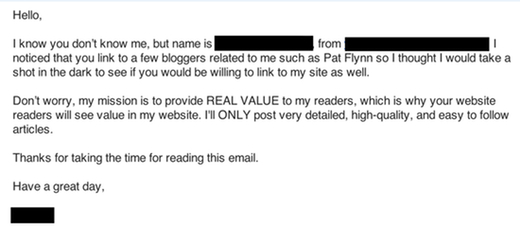
Now can you tell me what this dude did wrong here?
Here’s a hint:
EVERYTHING in the email is about him.
There’s NOTHING in the email that gives me a reason to even CONSIDER sending him traffic.
I’m not pointing this out to make fun of this guy, because as I said, I believe he’s an honest dude who’s still learning the ropes.
The reason why I’m pointing this out is because I get a million of these emails each week.
So thing not to do #1:
If you’re contacting someone you don’t know, NEVER make it all about yourself.
This is actually a UNIVERSAL rule in life.
If you’d like to make a solid impression on someone, you should NEVER make the conversation about “ME ME ME ME.”
If you wanted to learn more about this very problem, I actually created a video and a free PDF where I go into this in detail. It’s called “How to email influential people.”
Want to Know How to Email Influential People (And Actually Get a Response)?
Download this free eBook to get the word-for-word scripts you can use to do exactly that.
Yes, send me the free ebookThat said…
Here’s Another Thing You Should NEVER Do…
Let me show a quick example:
“Hey Derek,
You’ve helped me out so much that I’d like to return the favor. If there’s anything you need help with, just let me know.”
What’s wrong here?
The email is clearly all about me, but it misses the mark… MASSIVELY.
Why?
When you send an email that says “If there’s anything you need help with, let me know,” you mean well, but you’re putting the onus on the person you’re emailing to “figure out” how you might be able to help them.
So, what you’re doing, in turn, is offering to help… and creating work for the person you’re trying to help.
They’re already busy, so the email often gets ignored.
And that leads me to thing not to do #2:
If you’re contacting someone you don’t know, NEVER extend a generic offer to help.
This is ALSO a universal rule of life.
So, whether you’re applying for a job, trying to land a new consulting engagement, or even looking for a way to partner up with someone you admire, it’s your job to present exactly how you’d like to work together… and the specific benefits of doing so.
But the question remains: Now that I know what NOT to do, what should I do?
And what if I feel like I have NOTHING to offer in return?
Keep reading.
The Dirty Little Secret Behind Getting People To Do Things For You…
As you might have noticed from “things not to do,” the real secret behind getting people to do things for you relies on one little word:
INCENTIVE!
If you want someone to do ANYTHING for you, you must provide them an incentive for doing so.
And the more important the person you’re contacting, the bigger incentive you must provide.
It’s really that simple.
I know we’re talking about blogging and links, but let me share a quick story about this guy Elliot Bisnow.
Back in 2008, Elliot was running a niche industry newsletter with his father. He had some questions about business and decided that the best advice would come from other young entrepreneurs.
But how could he get in contact with these other young entrepreneurs? That’s when he devised a simple plan. Here’s a direct quote from Inc. Magazine:
“Bisnow’s pitch was simple and, as it turned out, hard to turn down: Come out to Park City, Utah, and spend a few days skiing, hanging, and networking with other successful young entrepreneurs. The kicker? Bisnow agreed to pay their way.”
That’s it.
And guess what happened?
The young entrepreneurs (many of which were on the 30 under 30), were SOLD… All because Elliot provided a GREAT incentive to network.
But let’s take this back to you…
What incentive can YOU provide to someone?
That leads me to:
The Three Types of Incentives—Each Of Which Has The Potential To Be A Bullseye
A while back I read Freakonomics by Steven D. Levitt and Stephen J. Dubner. In it, they said there are 3 types of incentives:
- Economic incentives
- Social incentives
- Moral incentives.
To break each of them down, for simplicity’s sake, economic incentives involve money, social incentives involve fitting in (or meeting new people), and moral incentives involve “doing the greater good.”
Well, it turns out, when you want to contact someone, with hopes of persuading them to link you (or do something for you), you should appeal to one (or ALL) of these incentives.
(You’ll have to decide which works best).
To show you how this works, let me share some specific examples:
Example #1: The Economic Incentive
Back when I launched my podcast, I had the desire to feature world-renowned researchers, New York Times best-selling authors, and professors from top universities.
I had no connections in this space, but I wanted some. So, what did I do? I appealed to an economic incentive.
Here’s an example:
Dear John,
I noticed you have a book coming out in a few weeks, and I believe my readers, over at my blog, would eat it up. Would you be interested in doing a 20 minute interview, and I would feature it to all of my readers? We’ll also be able to end with a pitch for your book.
As you can see, what I want is this professor on my podcast. What he wants is to sell more of his books.
Did I email him and say, “I’d love to have you on my podcast because you’d be a great fit?”
No.
I made the email all about him… from an economic standpoint.
Let’s look at another example.
Example #2: The Social Incentive
The economic incentive was a bit self-explanatory, so how would this work from a social standpoint?
Here’s the example:
Dear John,
I recently read that piece of research you published, and I couldn’t help but wonder “Why doesn’t EVERYONE know about this?”
I was wondering, would you be interested in doing a quick 20 minute interview where we talk about this piece of research? In the past I’ve featured research from Max, someone I know you’ve worked with in the past, and I believe your research will be a big hit on my blog.
Now do you see what I did there?
I wasn’t talking about big readership numbers… I just merely mentioned that I covered some work from one of his colleagues (his colleague wasn’t even in an interview), and that I believe he’d fit in perfectly.
Social incentives at work.
Let’s look at the last incentive.
Example #3: The Moral Incentive
Let’s cut straight to it. Here’s the example:
Dear John,
I recently read that piece of research you published, and I couldn’t help but wonder “Why doesn’t EVERYONE know about this?”
As a matter of fact, this is one of the reasons why I launched my podcast Social Triggers. My big goal is to bring the insights from academic papers to the general public.
I was wondering, would you be interested in doing a quick 20 minute interview? We can highlight your research to all of my listeners, and hopefully we can both make the world a little bit smarter!
Now, to be quite honest, in this scenario, appealing to a moral incentive is quite weak, but I wanted to keep the examples consistent.
But do you see what I did there?
Instead of focusing on selling books, or joining your colleagues, I’m talking more about “making the world a better place… together.”
That’s a moral incentive in action.
And finally, let me show you how I’d use ALL THREE incentives at once.
Dear John,
I noticed you have a book coming out in a few weeks, and I believe my readers over at my blog would eat it up.
Would you be interested in doing a 30 minute interview where we talk about your book… and end with a pitch for your book?
Right now I’ve got more than 70,000 subscribers, and I suspect we could sell a few hundred books.
Thus far, I’ve featured people like Max, Jane, Dan, and other people whom I’m sure you’re familiar with. Would love to have your interview alongside theirs.
Let me know if you’re interested. I started this podcast as a way to promote the hard work of researchers like you, so I hope you have 30 minutes where I can highlight your new book.
See how that works?
As you pack on the incentives, the pitch gets more and more irresistible.
Now let’s take this back to asking bloggers to send you some of their readers.
What can you do?
How to Persuade Bloggers To Share Your Work With Their Readers
As you learned throughout this post, the secret to getting people to do something for you is providing an incentive to do it.
But how might this work with enticing people to share your work with their readers?
In my premium training, Blog that Converts, I walk you through 7 content archetypes that BEG to be shared…
…and how to use each of them.
I also walk you through the promotional strategies that light a fire under people and get them sharing / linking your stuff.
But for now, here’s what you need to know about getting people to link you:
While you MUST provide an incentive, you should NEVER make the other person feel “cheap.”
What do I mean by that?
Don’t come at someone and say, I’ll send you some traffic, if you send me some traffic.
That comes off as grimy.
Instead, what you need to do is this:
Review the type of work the person you’re emailing puts out IN DETAIL.
Then ask yourself, “Is there anything I can do to add to this conversation? Is there anything I can do to make this guy look better?”
And then do that.
As an example, let’s say I read an article by some blogger that said “Design is King.”
That blogger then went on to list the reasons why he believes design is king.
How would I reach out to him?
I’d say this:
Just read your article about “Design is King.” What’s funny is, I’ve always believed the same thing, and some people don’t. Well, check this: I stumbled on some research that PROVES design is king. It was done by a university in London, and I think you’ll dig it. Here’s the link.
What’s the incentive here?
There’s no seeming “economic, social, or moral” incentive, but it’s there… hidden in plain sight.
If I provide research suggesting that the person I’m emailing is RIGHT, then I’m giving him a reason why he’d LOVE to share my article with his fans. My article says he’s right, and people LOVE being right (that’s a social and economic incentive).
See how that works?
Okay, now I have some homework…
…and it’s going to be a fun one.
For tonight’s homework I want you to write a sample email where you show me how you’d convince someone you don’t know to do something for you.
And this could be anything… Do you want a link? Do you want them on an interview? Do you want to guest post?
Show me how you’d convince them to do it by leaving a comment below.
And remember, when writing your email, try to appeal to all three incentives.
I’ll read every single comment, and I’ll even pop in and give some people feedback on some of your sample emails.
Want to Know How to Email Influential People (And Actually Get a Response)?
Download this free eBook to get the word-for-word scripts you can use to do exactly that.
Yes, send me the free ebook






Excellent, your content really was useful.
Ravishing and interesting article this is really very awesome and brilliant content thanks.
Hi Derek,
I just read your article on how believing in a higher power can improve all of your social relationships. I want you to know I believed this for the longest time and I’m so happy to hear it becoming so popular.
I write all about this on my blog and I would love to have you share some words to my subscribers. I’m sure they would love it and I’m sure you’ll get some more subscribers for yourself.
I’ve interviewed many other experts in the field and I would love to share your options along side theirs.
I started this project to change the world and help people lead more successful lives and relationship, all the while improving their relationship with G-d. I would love for you to teach some of my subscribes.
Thank you!
Hi Derek and social triggers team.
Something is bothering me is this. 1. If there is some one contacting me that I don’t know about. I would leave it alone and I have nothing to do with them plus About, never about talk myself is just lame because I would talk it over with them even though I don’t know them .and we don’t boast about myself. 2. I agree about if there is someone contact me I don’t know about never offer any advice is a bad thing because I believe that communication is the key if not then we don’t what we are planning or guessing what they want only what we want if they don’t speak up.
Homework Challenge, accepted!
Dear Derek,
I see you are in the process of anvailing another priceless course to your readers, Seven Figure Courses, and I believe my audience will benefit from this a lot.
I was wondering if you would be available for a 20 min interview to discuss the course in greater detail. We can open with a brief intro the course, and end with a more detailed presentation.
In the past I had great leaders like Tim, and Tony, featured on my blog, as well as some others you may be familiar with. I would love to have your interview alongside theirs.
I had started my site as a means to help people realize their true potential, and help them grow, become happier, and be able to develop healthier relationships in their life. I hope you can will able to join me for the interview, and maybe together we can help people realize their passion, and create a healthier, better world.
Aleander,
Founder of TheLoveMethod
But what if they respond and say “Thanks, I’ll read it over!”, what do you do next?
Do you check up on them a few days later? Do you ask that they share it? That’s the part I haven’t figured out yet
Hi Derek,
We are a product company focusing on psychometric analysis of our audience leading to automated and accurate hiring&firing strategies adopted by companies worldwide.
I stumbled across from your articles starting with “How to get 5000 subscribers”, “What people buy” and finally “How to persuade people” . Goes unsaid, Great insights and unique takeaways on all these topics (and I speak on behalf of my superiors).
I was hoping that you can take some time off your hectic schedule and enlighten us with your thoughts on “What are the first things that any company/business looks for in the people they hire”.
We would like our audience to hear from the best in the market and share your insights to the person next to them using digital marketing techniques using our product.
Thanks
I am a struggling photographer who just discovered your blog and now trying to figure out how to apply your tips to my business. I am a mom who just recently turned to be the sole provider to the family who needs help so bad because I am freaking out how we could work this out financially. I have 2 girls whom I need to provide food and shelter. I don’t have a way to match my husband’s previous income and unfortunately he is in a bad place and not able to help out even if he wants to. I am looking for ways to book photoshoot coz that is the only fast access I have right now. What I love to do and that would keep me sane and a happier mom to my children despite all the chaos in life right now. So your articles are such a big help.
But I clearly don’t have anything to offer compared to your examples there. Even social, economic and moral.
Dear Derek,
This is a great info! I recently found out about Zippy Course & Social Triggers from Facebook. After watching your first video, I immediately got hooked and became a customer for your software. All of the articles and videos are mind blowing! And I started to wonder “How come nobody around me know about this?”
I’m working on a Entrepreneur Startup Courses, (http://ellenpro.com) I’m just wondering if I can feature you in one of the lessons? It will just be a quick 20min interview. I would like to get more people hooked with your articles and videos.
I look forward to hear from you.
Ellen Lin
Derek Halpern, I speak directly to YOU.
Hello Derek,
Recently I’ve stumbled across some of your content and while still obscure I personally believe that you are on the RIGHT track.
I realize content is specific and that specified content is the ONLY subject your present to your viewers, as with any other social mediaist. While this isn’t WRONG it is TERRIBLY obsCURE.
To elaborate on that, I as the individual have no sense of connection to you, also the individual other than the Specifically Honed, Informative Text. As two individuals trying to connect for the greater GOOD of whatever purpose may be I HIGHLY recommend you deeply consider my words.
My name is Raven and my methods transcend what we know as the physical internet. If that sounds far fetched then you can certainly believe YOU have plenty to learn from ME. Using a highly specific combination and form of PSYCHOLOGY and MARKETING I’ve learned how to not only tap into peoples interest and emotions but also their ambitions. Their direction and motivation. Frankly put, to cultivate a SELF perpetuating fan base.
If this CATCHes your attention then please don’t reply with ANYTHING other than a friendly handshake and an interest in marketing and self growth.
Sincerely yours, Raven.
Great stuff Derek.
While I found some of your examples tailored to your massive size audience, meaning, you have a huge leverage because you have 70,000 readers, so it makes your requests a little more convincing, still…great ideas.
I m taking your homework challenge 🙂
Dear Jane,
I just finished reading your article. It provided great information and actionable tips that very yoga teacher should know.
Would you be interested in doing a twenty minute video where we talk about your program? I am positive my audience will be excited to hear from you and we can feature your program in the process?
I recently did a talk with a teacher who finished their training in India, though I find that your experience has more value.
With so much information on the web, and yoga teachers balancing their time between home, classroom and day job, we can help provide them with action tips to help them.
Thank you for your time,
Gabriel
Hi Derek
I just wanted to thank you for this great post. I was getting lost in all the facebook and social media maze but after reading your ebook “how to get your first 5000 subscribers” and reading your post, I was very impressed. I found your articles easy to understand and the content very beneficial. I really wanted to try them out but I don’t have a blog (I am not a very good writer). Instead I have 2 Etsy shops that are getting small traffic but no conversion so I started thinking how to apply your principles to an Etsy business and I believe that it can be done however I just can’t seem to figure it out the incentive to a blogger to feature your etsy store on their blog? Offer them a free product maybe? That seems to be still focusing on ME instead of THEM. any advise in that area would be greatly appreciated.
Thank you again
ghayda
OK, here’s one. I have been wanting to post on a site called craft test dummies, but that will all be explained in my email. Should I send it?
Dear Jenni,
I was first attracted to your blog after I had spent about 6 to 7 trips to the craft store trying to stamp silk flowers. Because know one was able to offer me direction, I purchased several types of ink and did experiments. It was this particular incident that led me to subscribe to your blog. It also was one of the events in my decision to begin a business teaching local people arts and crafts. I thought this article about my ink trials would be a helpful addition for your readers, since your blog is about testing and comparing products, which has been a Godsend for me.
Then I would put the link
Personally if I liked an article, I would be happy to post the work of someone else, but I have 0 readers, so what do I know.
Derek,
Signed up for your email, reading your ebook to get 5k Subscribers, and I am eating up all of your content. It JUST MAKES SENSE. The area of the web that I am in is still stuck in the 90’s. What do we sell? Jesus (you don’t actually buy Jesus, or grace, but evangelism is basically selling right?).
It just gets under my skin how bad people in ministry tend to be with the internet. I am trying to learn how to do it better, and you are helping.
I am having a little trouble transferring some of the principles to a “pastor blog.”
The drafting technique seems to be something that is more easily applicable for driving traffic. Offering a pastor’s perspective on news stories, that can be just the polarizing thing to make the journalist go viral.
But as for other parts of your techniques I could use some help. Would you take 5 minutes to take a look at my website http://www.jacobfields.org and send me your quickest initial impression of things I should change?
I will implement your findings and do an article about how you have helped and how I think other people in ministry should implement your Psychology + Marketing tactics.
Lets change the way people in ministry use the internet.
Dear Derek,
Your post is well thought out. But as I kept reading, I wondered if all those “incentives” were not a bit “too obvious”, and, eventually, manipulative? and if one can perceive the psychological manipulation, doesn’t that crushes the “moral incentive” big time?
Anyway, your post was interesting enough to urge me to write this comment, even if I don’t offer you anything, and don’t ask anything from you in return.
Hi,
Loved the post and especially the part about the three types of Incentives to get people to do what you want them to, I think it really does works.
Thanks for sharing!
Your strategy of stacking incentives is excellent. I’ve been studying a lot of marketing psychology lately and what you posted here has tremendous value. It can be applied is not just in marketing and business, but in life.
I do have a question about the example you gave where the blogger is trying to get a link from the high traffic blog for finding the “Design is King” research. In the example email you stated: “I stumbled on some research that PROVES design is king. It was done by a university in London, and I think you’ll dig it. Here’s the link.”
Thanks Derek,
I’ve used similar emails to interview over 150 guests for my podcast that features authors and coaches and connects potential promotional joint venture partners. It’s been a great way to get a steady flow of guests for my weekly JV ATTRACTION newsletter and blog!
Keep up the great tips and resources!
Derek,
You seem to have the magic that works! I went back to see your response to Lindsey Matre, that had such a HUGE success for her from your feedback, but I couldn’t find it. I too, am looking for the RIGHT words to say as I am linking up with others through LinkedIn to network my way into a company to get hired.
Please share your expertise, as you have helped so many others here.
Thank you in advance,
Heidi
Hello Derek,
Wonderful work! I appreciate the advice and knowledge you shared, it lead to a great turn out for me.
I will make a long story short.
I am currently job hunting, and was having a hard time. I decided to start contacting elite members of the industry to try and network that way. With your guidelines, I created an email that got me a response within 8 hours.
I followed up, and received another reply in 3 hours. With another reply, I received an invite to meet up and discuss how he could help me find a job!
We meet tomorrow and I owe a big thank you to you Derek!
Best wishes,
Lindsey
Hello Lindsey,
I was wondering if I could see the email you sent. Especially since yours was such a success. (iampoisedinc@gmail.com). Please and Thank you in advance.
Best wishes,
Jessica
My name is Trisha from Singapore. I have to give this miraculous testimony, which is so unbelievable until now. I had a problem with my Ex husband a year ago, which lead to our break up. when he broke up with me, I was not my self again, i felt so empty inside me, my love and financial situation became worst, until a close friend of mine told me about a spell caster who helped her in the same problem too his name is Dr Stanley. I email Dr Stanley the spell caster and i told him my problem and i did what he asked of me, to cut the long story short. Before i knew what was happening my husband gave me a call and told me that he was coming back to me in just 3days and was so happy to have him back to me. We have two kids together and we are happy with ourselves. Thanks to Dr Stanley for saving my relationship and for also saving others own too. continue your good work, If you are interested to contact him and testify this blessings like me, the great spell caster email address is (drstanleyspelltemple@hotmail.com) you are the best among all the spell caster online I hope you see my testimonies and also pray for my family too.
I’d love to see some more examples that aren’t for podcasts or interviews – since I don’t do either and am completely self-serving 😛
Derek,
Now I get why I have had varied success. While it is rare for me to contact other bloggers (I would rather focus more on future career contacts), I do often contact professors and professionals. From the first one I contacted I just got a curt reply, responding in bullet points to all of my questions. Because it was only about me. I was asking for a hand out.
When I contacted a publisher I had more success, even though I had no idea what I was doing. I was offering something new (a journal of student reactions to their education), and I was willing to do most the work. I offered economical, social, and moral incentive. And when I contacted Florentin Smarandache, asking about any paradoxist music that he had composed or knew of, I got more than I had bargained for. Rather than just information, I got permission to compose the first piece of paradoxist music. I didn’t even have to ask. But I really didn’t appeal to any of the incentives you mentioned. I would say that there is another incentive, pride incentive. If you are willing to do the people a favor, because it will help you too, then they are willing to help.
There are also some basic things that should be done, but often aren’t. Any time I contact a new person, I use Mr. or Mrs. or Prof. And most often, when I get a reply, it is Mr. And I am in highschool. Also, people should really use a signature. I use “Thank you” because I know that I am appealing to their authority, but if I were to do it for something else, I would use a different one. Finally, when I do e-mail someone, I always include a quick story of who I am, and then why I am contacting them. That way, it doesn’t seem like I am just saying hi for the kicks. Subject lines are important too.
This advice is aimed mostly at my generation. On educator blogs their seems to be a uniform agreement that their students communications skills are lacking. This post might make good required reading.
Regards,
John
Thanks for sharing your expertise. Very useful. I don’t read long emails either.
Hey Derek, this is absolutely AMAZING.
I just wrote my first premium piece of content (links in sig) and i used two of these exact tactics to get my work pimped out on Facebook by a very popular blogger in the mark money online space (financial + moral).
Thanks again,
Hi Derek
I appreciate you sharing your expertise with me … much of it without asking for a thing in return. You’re kind of like a lighthouse to my blogging aspirations. I take your advice to heart and consider how I can incorporate it into my own efforts. Just wanted to let you know you’re appreciated.
I did the home work – yay me!
Hey April,
I’ve been a dedicated reader of yours for a few years now, and I believe my readers would fall in love with you immediately.
Would you be interested in doing a 20 minute interview, where we talk about blogging techniques, tips and tricks, in honor of the last time you’re offering your blogging course?
We have a very condensed readers base of crafters who REALLY want to make a difference and most of the time there blog can do all that and more – they’re just doing it wrong. But you know exactly what I mean, don’t you Missy?
I’ve also featured the founder of 3BStreet, an alternative to Etsy where the sellers must apply and the website is orientated around the buyers. I also do frequent guest posts on there blog – which is where my point comes in. The community on 3BStreet would love you just as much as my readers.
Please let me know if you’re interested, it would make me giggle like a fool to get a yes! Hope you have 20 minutes to highlight your course as it goes out with a bang!
Brandon
Haha, I wish I would have seen this post before reaching out to you, Derek. 🙂
Derek:
Your strategy of stacking incentives is excellent. I’ve been studying a lot of marketing psychology lately and what you posted here has tremendous value. It can be applied is not just in marketing and business, but in life.
I do have a question about the example you gave where the blogger is trying to get a link from the high traffic blog for finding the “Design is King” research. In the example email you stated: “I stumbled on some research that PROVES design is king. It was done by a university in London, and I think you’ll dig it. Here’s the link.”
My question is this: If this link is to the research that he found, how does the blogger who found the research get a link to his site? After all, getting a link to his site is his primary motivation — right?
Wouldn’t the smaller blogger who wants the link be better off doing a post on his site about this research and then linking to the research from within that post. Then write the high traffic blogger and tell him that you found research that proves he is right. And then say: “I just wrote a post on my blog where I tell my readers about research that was conducted by a university in London that PROVES you are right — that Design is King. Here is the link to the article I wrote. I believe both you and your readers will find it to be of great value.”
This is a really great piece. You don’t realise how much science and pragmatics are behind something as simple as contacting someone you don’t know but you’re right.
You only get one shot at that first contact so it’s important to get the tine exactly right.
(Worked off of Claire’s!)
Hi Nicole!
I have absolutely loved your recent posts in prep for NYFW – welcome to the city!! I love that you’re here with us and braving the frigid weather as stylishly as ever!
I’m a Life Coach for women in their 20s and I know they’re all dying to hear from a happy, stylish, and successful young woman like yourself about how you’ve created the life of your wildest dreams. How would you like to do a short interview for my site to share the highlights of your story? So many Big Apple ladies will be thrilled to be introduced to you and your fabulous work – you’re such a vision of light that inspires young women!
Looking forward to hearing back from you!
Have a fantastic weekend!
Warmly,
Alessandra
Derek, I’m glad I found your site. Up to millions of visitors at my own blog mentioned that you had important things to offer and I see that they were right! Though, to be honest, we haven’t had a lot of time to visit other sites, given our own efforts to relieve poverty worldwide through online education about this new economy. Keep up the good work and we can both help build a better future for people around the world! Feel free to stop by!
I just want to clarify: when you say to provide them with the link, would this link be to your or–in this case-our particular blog post; or would it be to the research itself? If it were our blog post, that particular post would discuss the research we found then I presume.
Love the article Derek. Going to test some of these techniques out and test to see how we can continuously improve results.
Strange but true. I am reading your stuff and thnking how to get the P S in the Ministry of… to give some funds to the Project I am presently working on. And just by Magic, I received an Email from one of the most important institution. It read in part: Dear Mr Batson: Thanks for this information. We have a small fund that considers applications of this kind. I am asking the chair of the committee that handles this fund to respond to you. I will send her the additional information you forwarded as well. All the best.
It take me a little while to get things to sink in, but, when I believe in them, it works for me. What I am really saying in this, it took me ten years of hard work and suffering to get these influential people to answer my Emails, but, I never gave-up.
This is the other Email I received today about the appointment tomorrow. Good afternoon Mr. Batson,
I left you a voice mail indicating that we will meet with you tomorrow
at 2pm. We look forward to seeing you punctually at that time.
Two importnt mails in one day. That is why I am here tonight doing my home-to-work, (my programme for working at home) readng your Emails and Blogs, preparing for my appointment tomorrow. To sum it up, all good things come to those who wait. Most importantly, a man is known by the company he keeps. This could be a small Blog(Ha,Ha). Looking forward to the Email you promise with the Video next week. Trevor.
Hi Derek,
I have a real estate site where I post original content, and it produces leads almost every day, the problem has been to convert them….I have tested a lot of different responses, soft sell, hard sell, generic, etc., but the end result was always low conversion rates – maybe 1 in 70 ended up becoming a client…from your teaching, I can see that I have been doing it wrong….
So, today I used your incentive template as a model(hopefully correctly), here’s what I wrote regarding an information request from an out of town buyer, for a townhouse or condo in the Toronto suburb of Mississauga, Canada..
Hi ….,
I see you are interested in finding a condo/townhouse, and that you are a socially active couple. I believe there are multiple properties in the Mississauga area, which you would find attractive. Would you be interested if I were to start sending you some suitable places for you to review? We could narrow it down to the areas that you like, and the price range that you want. I could also show you some in person, if your travel plans permit.
Best regards,
What do you think, is this on the right track? Fingers crossed they will answer back….thanks, and greetings from Canada..
THANK YOU!!! This blog has already helped me land two HUGE teleseminars this year!!!
Hollaaaaa!!
Ok Derek, here is my letter. It is not a prototype, this offer is real and yes, it is written to you. Teach me how I can best reach out to this guy named Derek Halpern. 😉
Hi Derek:
You hand out some of the best advice on the planet when it comes to building an online audience. You have created a bully pulpit out of whole cloth in a breathtakingly short period of time.
I’ll bet you have a frustrating problem that just about every successful guru faces: people don’t follow your directions. The problem isn’t you. You are a great communicator (for all your bowing and scraping about not being a good writer).
The problem is simply that many, if not most people lack clarity. Without clarity, all your wisdom bounces off these poor folks like a rubber ball. They really need what you offer but it just can’t get past their own personal fog.
I have a solution for you. I offer a free 45-page guide to clarity entitled “How To Get Clarity and Hold On To It”. Anyone who signs up for my newsletter receives a free copy. Helping your followers get more clear will allow them to more effectively implement what you preach. And when they are more effective, your star rises even higher.
You (or anyone else you like) can find it at veraclaritas.com. Let me soften up the ground for you to do that amazing thing you do.
Pleas let me know if this guide is something that could benefit your followers.
Regards,
Kenneth Vogt
veraclaritas.com
True story – last week got motivated by your post to reach out to one of the BIGGEST bloggers in the parenting sphere fully expecting to get ignored/rejected. Used your techniques to persuade.
BAM got a lovely response and she agreed to an interview! [insert mic drop]
Thanks so much for the great suggestions that WORK!
Derek,
Thanks for the article…really well laid out and the examples are perfect. It’s good to think about this stuff…so easy to just fire off an email without really thinking about how it will be received and if it’s actually got a chance to accomplish anything. Absolutely worth taking the time to consider the three main incentives. Thanks.
Thank you for sharing this with us. I found it useful. I tried it after reading and got a yes from the invitation.
Awesome, as always, Derek 🙂
I believe there’s one more way to get others to help you, and it’s a rather surprising one.
And it requires vulnerability, authenticity, and sincerity. It’s something you can’t really ‘fake’.
When I was on my last legs, homeless, betrayed, my life’s work stolen, I had no clear “economic, social, or moral” incentives to offer… all I had was an honest cry for help.
It takes courage to ask for help, courage to show ‘weakness’, and courage to express one’s self.
I did it, and the response, support, and help extended to me felt like heaven. Probably saved my life.
What was being leveraged in my case?
“The giving, loving, altruistic, species-expanding leanings of humanity.”
Food for thought – especially, for anyone who’s feel up against a wall, and who are unaware of clear incentives.
Thank for a great article. I loved the examples you gave of each type of incentives.
Ouch. Wanted to print the article, ended up with 39 pages, most of which comments, many of which said “awesome post” and many other of which said “please visit my blog and leave a nice comment”.
Well, in recent years, I learned the hard way that I had to remove almost every possibility of interaction from my web sites – which sucks – so please do not visit any of my web sites. They’ll bore you to death.
Hahahaha, Angelina… that’ll happen sometimes with larger blogs like Social Triggers 🙂
You’re encouraging people NOT to visit your blog? Well… that’s… refreshing? lol.
Here’s my email to larger bloggers requesting to guest post for them:
Bigger Blogger,
I love your site and think you’re providing awesome information that truly helps and inspires people. I especially liked your articles about X. I write at Simple Mindfulness [link] about how people can use mindfulness in simple ways to become happier.
Since we share a passion for helping people live better, I’d love to write a guest post for you to delve deeper into how mindfulness can improve their lives/finances/relationships [based on their blog topic]. The popularity of mindfulness has been growing like crazy with recent articles in The Huffington Post and Harvard Business Review (of all places) so additional articles on mindfulness on your site would most likely grow your readership.
Let me know if this interests you and I’ll write a beautiful, original post that blends well with the style of your site.
Thanks so much!
Paige
I’ve been following those two rules (make it about them, don’t make them think) since I first read about them in that PDF you mentioned. I even got a guest post request from someone who broke both of those rules and I replied back telling them all about it.
I’m interested to know if you actually do read every single comment Derek, because you get a lot of them. You should reply to my comment to prove you actually do.
Dear Derek and Social Triggers Readers,
I noticed you have a knack for networking and marketing, and I believe you would be amazing in my business.
Would you be interested in watching about 15 minutes worth of videos about our product and business? I’m looking for leaders such as yourself, who are not only willing to learn, but also willing to teach.
Right now I’ve got about 20 people on my team, and I suspect we could destroy this market with your expertise. We have people making $40.000 a month in their first year in the business, but they haven’t seen you at work yet.
We would be helping people get into a better lifestyle, whatever that means to them. Our product is an amazing nutritional supplement, and I believe it would help you, as much as you can help it.
Let me know if you’re interested. I originally started my business for my own financial gain, but now I’m out to help other people create their own financial well-being, as well as meet their own health goals. I lost 39 pounds in my first 90 days, and I would love to hear your success story!
-Casey Harrison
great post.
BUT!
i don’t mean to be a stickler derek, but i don’t see where you deliver on the promise you give in your title. the script you provide that includes all 3 reasons, doesn’t include how the interview would translate into that person linking you (or me) on his or her site.
is it just a given that if you interview someone that person will turn around and share it with his or her audience?
i’m just drafting some emails now, and want to get your feedback on this.
thanks!
alison
I agree with Alison, and am interested in Derek’s insight as well.
I did something like this on a small scale – I asked 5 bloggers to share one tip each on a certain subject, and compiled the tips into a roundup-type post. I tweeted the blog post, and a lot of the bloggers retweeted me and the blog link, and posted it on Pinterest where I got a lot of repins – but that was all they did to promote the post to my knowledge (I did ask them to share the post with their networks).
BUT, that roundup post did get 400 views in one week – the highest traffic post I’ve had so far. So I have to believe the bloggers promoted it in other ways, but am interested in a more concrete way to ask or achieve cross-promotion.
Hi – what an AMAZING article. I was referred here by Jamie at The Modern Tog. I am working on an approach today and this has made all the difference. Thanks so much!! I’ll come back and post when I figure it out.
Thank for a great article. I loved the examples you gave of each type of incentives. Make it very easy to see how to implement the suggestions.
Hey Derek —
One tactic I’ve used before that worked well was this: I scanned a blog’s content to see if the author mentioned any issues (in this case, back pain), and then specifically emailed the author with a blog post I had already written solving the problem.
A few days later I got a super excited “thank you” email, and then the author featured me on their blog. Pretty cool.
Not sure if that would work on an A-lister, but it definitely highlights the importance of giving value to someone else and focusing on them.
this is a great tip.
Dear Derek,
You truly inspire me to take action. Here’s an actual email I sent and did get a response from the authors VA. I followed up with deets and I am anxiously awaiting a response. Fearful I blew it with the follow up. Would love to hear what you think of my first email because I’m getting ready to send it out to others that align with my work. Thanks Derek for your inspiration!
Trisha
Dear (Author)
I purchased __________ (their home study program back in August), and I have been highly motivated by the content.
It would be an honor to introduce you to a workshop I offer. It aligns with your new book (name of book here) perfectly.
I have conducted it many times, witnessing impactful results, creating major shifts, including my own, that has led to people healing themselves.
It’s been quoted by Louise Hay as “A healing process that is fun…and it works!”
And by Bernie Siegel, M.D., “ It will help you get in touch with your true self.”
With your delighted experience of this workshop, I would love to promote your new book. I suspect I could generate at least a few hundred sales just from featuring you in my blog and during my workshops.
I am affiliated with a retail store where I conduct my workshops. We have contact with many seekers and healers within our city. Plus, they sell books of this very nature. I’m sure your book will fly off the shelf!
If you’re interested please let me know and we can figure out the details.
With gratitude,
hey Derek, another inspiring blog post!
I aim to put this to good use with getting guest blog posts for my site.
Thanks
Nicely done D! Just launched a 10k email survey for local golfers to find out exactly what they want and what’s preventing them from coming back. You can figure out the incentive by digging a little deeper and getting to their needs, pain and wants.
Great post!
Thanks for the thorough discussion of using insentives to ask for help. When i first started out, most people in my niche wouldn’t return my phone calls or emails, so i sat down and asked myself what could I do for them that would get their attention. I decided that everyone wants inbound links, so i started creating pages of links to amusement based businesses and the companies that supply them. Each time I created a link, I emailed the company’s owner and asked them to review the link and approve it. I also told them that it didn’t cost anything not even a reciprocal link but i wanted them on my email mailing list for new products and vendors. Some of them have added links to me on their sites. And quite often i get new equipment listings from people right after i send out the weekly emails. However, I need to do more thinking in the area of incentives as I plan to start my own podcast by the end of the month. thanks again and take care, Max
Greetings Derek,
This email was an eye opener and i was inspired how with just using the right techniques can be the difference in being able to change people’s lives.
I was hoping you would link people to my blog as I see we share the same passion of making a difference and I would definitely like to recommend my readers to get to know you as THE EXPERT on blogging.
Sincerely
Pinny
This article has given me the tools to approach 3 influencers I’ve identified. I haven’t done it before now because I didn’t know the best way to approach them. Thanks for providing actionable advice. I’ll turn my homework in tomorrow AM.
Hi ___,
Major kudos to you on the work you’re doing. Your blog content always amazes me and forces me to pass your link on to my network – who NEED to know what you’re talking about.
(And from the reposting / retweeting I keep seeing, it’s clear a number of my readers want to help get your message out there too.)
I’d love to feature your writing on my blog to get you in front of the rest of my audience not as familiar with you as I am. Would you be interested in writing a blog post if it put you in front of a new market and advertised the great list of books you’ve written?
Can’t wait to see my friends eat up your writing like I do!
SM
Hi Derek,
My name is Susan McMullen and I co-host a radio show called The “Better You” Project which focuses on the entrepreneurial journey. We interview all types of entrepreneurs including creatives, authors, bloggers, professional services, speakers, etc., with the purpose of providing other entrepreneurs with resources, connections, encouragement and inspiration.
I have followed your blog, Social Triggers, for quite a while and believe you would be a perfect guest for our show. I love your no-nonsense, straightforward style of delivery. Not only do you freely provide excellent information that our listeners could use, but you also have an inspirational success story that I believe they can aspire to.
I am also familiar with your advanced training, Blogs That Convert, and I believe our listeners would be very interested in learning these techniques from you. We could certainly provide a pitch for this at the end of the interview. In addition, your show would be archived and, if you would like, we could provide you the link for your audience so they could download and hear your interview at their convenience.
If you would be interested in sharing more about your story by being a guest on our show, please contact me at susan@thebetteryouproject.com. Thank you for your time. I look forward to hearing from you.
Susan
Derek,
I have often found in life the right things happen at the right time if it is exactly what you are supposed to be doing when you are doing it. In saying that, once again, your timing is *PERFECT*, so thank you for being the guide:)
On to my homework, I actually have met this person several times and we have a lot of connections in common, but I have not seen or spoken to her in many years and she has a lot of power and influence in a specific area of the equestrian industry that I am also tapping into (I feel like I am really putting myself out there on this homework assignment btw!!!).
Dear Carolyn,
It has been a few years since we last saw each other so I am hoping you remember who I am. I am Wanda’s friend who was Ed’s apprentice for 12 years. Now, with both Ray’s and Ed’s passing, I was at a crossroads as to what path I should take: continue on with Ed’s legacy and teach myself, or find a way to teach millions of the concepts Ed and Ray both held so dear to their hearts.
Just like you, I knew that it was very important to get the concepts Ed and Ray taught to as many people across the globe as possible. I came to the conclusion that a video-based education website was the best way to do it. Over the past year, I have reached out to and started filming several people who have also dedicated their lives to great horsemanship. Many of those same people reference Ray and Tom as their teachers, mentors and inspirations to be better horsemen and women.
I know you have the Legacy of Legends coming up in a few weeks and Melanie and Mindy will both be there, both of whom I have worked with quite extensively this year. Since you are now the voice of Ray, I would like to feature you on my site as well. In addition, I would like to use some of the proceeds generated from the website to sponsor an apprentice through Legacy of Legends, 2014.
I am in the process of launching the site now and will be up and running with personal insights and introductory videos by the first week of February. I encourage you to take a look at what I have up thus far at: http://www.clinichorsemanship.com . I also encourage you to speak with Melanie and Mindy while you are in Las Vegas to get a litmus test of their experiences with me this past year. I have several other projects and ideas I would like to share with you as well that I believe would be greatly beneficial to you and your cause and the future of your cause.
You are welcome to reach out to me at: xxx-xxx-xxxx. I would love for us to get together in the very near future to talk and I am happy to come out to you. I will be in Texas at the end of March, so if you will still be down there I would love to come out to see you if you are available.
Talk with you soon,
Lauren
ClinicHorsemanship,com, LLC
Well, I guess Gary Vaynerchuck just blew your strategy out of the water. Did you see his offer? http://garyvaynerchuk.com/1adayqanda/ He’s interviewing anyone for their blog or podcast every day for the rest of the year. All you have to do is ask.
Ok. so he’s different. You do have some good stuff here. Here’s my homework.
Dear [Life Coach Type],
I know you’re great at helping people make changes in their lives, break bad habits, and fulfill their dreams. Your post yesterday on thinking big was epic. I do a similar thing except I focus on curiosity as a main driver for action. I think both of our audiences would benefit from a different angle on the subject, so I was wondering if we could do a podcast interview to share with our tribes.
I’m also working on an upcoming book and would be willing to list you as one of my mentors who helped me understand the foundation for change in my life.
Are you up for it?
Thanks.
Rex
http://areyoucuriousenough.com
Love this post!
I just want to add that this applies to dating as well. I get tons of fb messages that just say hi how are you? I will never respond not even if you say hi everyday.
Also what doesn’t work “I would love to take you to dinner.” You should never lead with that it’s creepy if we haven’t ever talked.
What does work is exactly what you state in this post, someone write a geniune message that shows they are paying attention to what you care about. I’ve met dozens of great people in real life because of social media messages and emails. And blocked many more ha.
Hi Derek,
Here goes… I do have a specific blogger/author in mind.
Dear ______,
Recently got my pre-order copy of your new book on sales and am lovin’ it so far… just like your previous books. In fact, the review I did of your last book STILL, almost 3 years later, gets visitors every month and has received almost 4,800 total views. Hope it helped make some sales.
I think my blog readers, who are primarily small to mid-size business owners and event management professionals, would enjoy hearing more about your new book… directly from you. In addition to a regular book review post as I would normally do, would you be interested in doing a quick 10 to 20 minute recorded interview with me that I can share with my readers on the topic of _______? We can schedule this on a day and time that is convenient for you. I would prepare and share interview questions with you in advance.
Because so many small business owners struggle with this issue, I think giving them some of your additional insight will encourage them to implement these new sales strategies for today’s economic reality (and encourage them to wander over to Amazon to buy your book, too). 🙂
Looking forward to hearing from you!
Heidi
It’s also helpful if the people you’re reaching out to are motivated. If their not motivated, you’ll have a much larger hill to climb.
Hi Derek – great post. I finally feel like my homework is ready to release to the masses!
Hi (blogger),
Marie Forleo introduced me to your work yesterday and I instantly fell in love. Your message, voice, and approach to wellness is so refreshing, right up there with some of my favorite bloggers like, Sam Johnson and Peter Smith, you bring energy to your content!
As I was browsing your blog, I noticed that you have a passion for smoothies. From reading the comments from your readers, it sounds like they’re itching for a couple of dairy-free smoothie recipes to join your collection. Many of my most popular posts on my blog, some of which have received over 50,000 views in one day, are of dairy-free smoothies. They’re a hot commodity!
I’d love to create a new dairy-free smoothie recipe and ‘how-to’ guide on dairy-free smoothies for you to share with your readers. A post like this will surely enable us to get a healthy breakfast smoothie in the hands of everyone, no matter their dietary preference! I also suspect that the feature will easily convert into a couple thousand new visitors for you when I send my readers over to your blog for the new recipe.
Looking forward to working with you!
Leanne
http://www.healthfulpursuit.com
Hey Derek
Another awesome blog. I use your blogs often in my classroom and assign the homework you recommend to my students. We all have lots of fun with the outcomes, and I’m sure the set of papers from this assignment will be particularly interesting and informative. You speak into the listening of my students. Thank you.
Burt Binner
I’ve always wanted to learn how to send emails probably. It’s always been something I’ve been a little afraid of doing, primarily because I would never know how to approach the person/company I was approaching.
Great tips! Bookmarked this post for life!
Spot on dude! Totally worth the read!
I never thought to interview people before, so this is great to offer expertise in areas that im lacking. My website gets maybe 70 visitors a day, so it might help to build readership in the first place.
I had this crazy experience. Last year I created a decently valuable chart. It was shared on pinterest and eventually picked up by a big blog (200k/monthly with 5k followers) I watched in awe as my stats crept up to 3k new visits in 2 days, plus 25 new likes and 10 new subscribers. It quickly fell off as the post aged, but wow was it exciting.
Ive been trying to figure out how to approach other blogs with this same chart, or if its even a good idea.
If anyone approaches bloggers with premade content like this, a chart, pdf or ebook, Id love to hear about it.
Hey Trisha!
Without knowing your exact niche, I hope this will apply. I recently started contacting several WAHM and similar blogging sites to offer guest blogging, and approached them from the viewpoint of 19 years experience, author, speaker, and more specifically, how I share a common goal with their audience. Would they consider reviewing a few guests posts/articles?
I got a 100% YES as many of these sites are solo-preneurs, as most of us are, and are time strapped and looking for good content to share!
I would think what you offer might have huge appeal to the right audience and infographics/charts are HOT! Good luck!
EXPECT Success!
Jackie Ulmer
Thanks Jackie! So, regular guest blogging would work here, thanks! I havent tried it yet because Im not a ‘writer’. But I know I can crack out a killer article about it. There were two color coded charts ‘when to start vegetable seeds according to temperature’. So I’ve got gardeners and survivalists and they’re loving it. And now is the time, so I sure will give it a shot. Thanks for the push!
One last question if anyone has a minute to answer. Would you create this article for more than one blog or would that just be cheesy? of course the content would be unique, but it would be the same topic and the same charts, since there are two maybe i would alternate.
Derek,
I’ve built ALL of my online businesses via email lists. I couldn’t agree with you more on every point you’ve touched on. Email has out performed every social media outlet I’ve ever tested it against and it WILL continue to do so for a LONG TIME. I wrote a detailed post on building your email list a few weeks back. Good to see I’m not the only one preaching this.
Best,
Edward
I am surprised how few of the comments are pitching you directly, Derek. Hmm, I haven’t yet either…I guess it comes down to do it right or don’t do it. “Don’t do it” is the right option if you can’t follow the formula or you need to queue up your ducks in a line first.
Kenneth, while he has a great and responsive audience, I don’t think most people here have his audience as THEIR target audience. While I’m sure there’s probably a few aspiring/new pro photogs reading his site (MY target reader), especially after he was on Creative Live, the percentage of his audience that would actually be in my ideal target market is likely so small that it’s not very effective to pitch to him.
You’d be way better off approaching a smaller blog in your own niche that shares your exact desired audience and can send you more of your target audience.
Sure, I’d love it if Derek promoted me or my site, but honestly it isn’t likely to materially help my own site or get me grow my list.
Jamie, you are of course correct in your own case and in the case of many other readers here. I was referring by implication (not very effectively, evidently) to those whose target market is a close match to Derek’s.
I’m struggling to find social or moral incentives when asking for an job interview.
Okay, homework time:
Hi Joe,
First of all, I wanted to say that I love your blog — not only the quality of the marketing advice you give, but that you focus on ethics. Not enough people do that in our industry!
I noticed that your blog is on page 2 in Google for “ethical internet marketing”, but I think it’s better than a lot of the pages that come up above it. I had an idea for how we might move it up to page 1.
I also blog about internet marketing, with a focus on ethics, and my blog is also on page 2. If we were to have a “conversation” between our blogs, where we periodically riff on and link to each others’ posts, since we both rank near the top, I’ll bet Google would move us both up. Since we don’t sell the same types of products, it would be mutually beneficial.
If that sounds like an interesting idea, take a look at WhiteHatCrew.com/blog/, and if your comfortable with my ethical stances, let me know.
I’m going to post a riff on your recent post about (XYZ) whether we end up doing this on an ongoing basis or not. But I wanted to throw the idea out there to see if you’d like to deliberately work together this way.
Thanks,
Antone Roundy
You are so informative. These are all great ideas and the timing of this article couldn’t have been better. I appreciate the homework challenge however, it would be quite ambitious of me to think I could complete this in one evening. hahaha I will add it to my to-do list. 🙂
Thanks Derek!
Awesome post. My focus is to help churches make the most of the resources they have, get the most bang for the buck in the technology department, and produce an environment that is inviting and welcoming while remaining unobtrusive or overt.
Dear Pastor __________,
I recently joined you in service and was blessed by your congregation. It is a wonderful thing to walk in to a building and feel like you are completely welcome. I would love to speak with you about how you are able to get so many people involved and on board. I am excited about the opportunities my church has been given in the community, and there are certainly things we have implemented that I think would be of benefit to other churches just like yours that have a congregation who is eager to step up and participate.
One of the things I am trying to do is build relationships with pastors like yourself from all denominations and locations to discover what it is that they are doing that is successful, and why whatever it is they are doing works in their situation. Pastors Tom Sterbens, Russell Mills, Kieth Murray, Buck Marshall, Jason McIntosh, and others all have growing, thriving ministries just like yours, and all have something unique that is helping to drive that growth.
I have discovered some great things along the way that I am certainly willing to share with you. It would be amazing to add your unique perspective to theirs, and to share with you the things they are doing (and almost as important – the things they have done that DIDN’T work) get tangible results.
I believe that through this shared knowledge, we can all be more effective and help other churches to grow as well.
I look forward to speaking with you.
Stephen Hoffman
In response to your “why bloggers fail” post, I went and emailed Steve from Nerd Fitness about what helped HIM get an active audience, and I linked to your post. The first line in his reply: “I cannot speak highly enough of Derek Halpern and Social Triggers.” Steve has also sparked in me a renewed interest in getting into contact with Art of Manliness blogger Brett McKay. Here’s what I might say to Brett, via snail mail since he doesn’t have a contact email listed on his site:
Hi Brett,
This is Paul from http://www.theReverbSignal.com. I’m a big fan of your website, especially posts such as Guitar Chords Every Man Should Know. Many people have trouble with sticking to a new habit, especially one like learning to play guitar, because they feel overwhelmed by everything there is to know. Posts like this enable them to get an immediate success and help motive them to keep running with it. Would you be interested in sharing some more of your experiences/successes/frustrations with learning guitar or any other instrument? I could feature your information on my site, and post a link for my readers to follow.
Regards,
Paul
I wanted to throw in 2 cents and an experience on what you shared about making the reader do more work ALA putting it on them to come up with some way you can help them.
The first live event I was part of planning and facilitating, we were total rookies. We had great speakers, an all star line up and all was good. We kept contacting our speakers and REMINDING them to mail to their own list for extra exposure and promotion, but we NEVER provided them with a sample email. Duh – we just “didn’t know!”
Finally, someone said, if you would make it easy on your speakers and simply email them the copy that they can use to send to their list, they likely will.
Well, no shocker, ticket sales shot up immediately as everyone started contacting their list.
Sometimes you don’t know what you don’t know but that taught me to ALWAYS make it as easy as possible on anyone I am working with, especially when they are doing ME the favor!
EXPECT Success!
Jackie Ulmer
Derek, this was an EPIC post (in several ways). Thanks for taking the time to give all of those sample emails. That was seriously helpful.
In response to your tips : It helps. more than a little, if you can say : “right now I have more than 70,000 readers”, surely ? Your own ‘credibility’ is established, from the get-go !
My favourite tip is the one re letting someone know how ‘right’ they are .. and offering to share the ‘evidence’ you’ve found. ‘Ego stroking’ is a great psychological incentive … when it doesn’t come across as patronizing, creepy or desperate !!
Derek,
FeeWise shows people how to be smarted about buying or selling a home.
Since your readers are conscious of social triggers, we think they might be interested in learning about some of the ways these can be and often are used in residential real estate.
The blog we’re working on now will have a series of articles about common yet avoidable housing market mistakes
Most likely a few hundred, maybe even a thousand, of your subscribers will buy a home this year, and that group could easily spend over $100 million in the process.
If I do a guest post on the subject for your readers, together we can cut down on the undesirable nonsense that occurs in the housing market by making your entire readership a little smarter, and save that select group a substantial sum in avoidable fees.
Thank you,
Ray Schmitz
So I’m writing this (the letter below) and wondering if it’s the right approach to getting more readership for me? My assumption is that the person would link back, but it feels insulting to ask.
I know that my previous reviews of two authors have strengthen my relationships with them. They retweet my comments and read my HuffPost blogs, but neither have mentioned me in their blog. So? Is this the best way to go? Or should I be asking to guest post? I could see a request to do a post that talks about how the book has helped me or how I’ve used their wisdom on my blog for my readers.
Hi Sex Expert,
I’ve just read the reviews of your new book on sexuality and the older woman. My blog targets a similar audience and I occasionally get questions from readers experiencing similar issues.
I would love to do a review of the book and include a short interview with you on why you think this topic is so important. I’ve done several book reviews, including Joan Price and Pamela Madsen.
Do you think this would be something we could do as part of your book promotion?
Walker
Hi Walker,
If you have done other book reviews, would it be more powerful to include a link to your review of their book? It comes across as, “I’ll only review your book if I can interview you.”
Good suggestion. Had to reread your second sentence but I get what you’re saying… In the theoretical case above I’ve yet to read the book.
Hi Derek,
How is this hw assignment sent to a media rep for My Black is Beautiful?
Hello Mrs. Howell ,
I wanted to take the time out to commend you and your organization on the great work you are doing to boost the self-esteem of young African American women in the community.
I too, believe that beauty and acceptance of one’s self is intrinsically linked to our self-esteem.
I recently read a piece of research that suggested 92% of the young women in the USA want to change some aspect of their physical appearance; making self-acceptance a major factor in the personal growth of our young women.
Would you be interested in an article helping women start their process of self acceptance and becoming emotionally liberated?
Please let me know if this interests you or your organization. I started my business to help women get to the core of their emotions and self-acceptance to lead happier and more fulfilled lives.
Ty Johnson-Anderson
Emotional Liberation Coach
an Ultimate rule about psychology is that people love to talk about themselves, I love to talk about myself, You love to talk about yourself
But the one who can make good relationships is the one who prohibit himself from talking about himself
I just sent an email to several blogs last night. Here is the message I sent:
I stumbled on some research that proves mobile friendly websites increase customer purchases. It was conducted at
by PewInternet, and the researchers found that when small business had a mobile friendly website, 67% of users were likely to purchase from the site. If you’d like me to forward that research your way, let me know and I’ll gladly send it over.
I used your template from the .pdf from “How to email influential People.” I did get one reply and was able to send them the link to my post.
How did I do?
Here’s my homework submission:
————————-
Dear (health/fitness website) –
I recently picked up your ebook about the perfect diet to lose those last (and toughest) 10 pounds. “Joel” of fitnesswebsite.com suggested you as a great source for dietary research and your advice resonated with how I approach my dietary practice and believe others should test as well.
My readers and listeners would love your ebook and can make major strides in becoming healthier with your advice. My listeners over at The Become a Beast Podcast would love to hear how you achieved the results you have and some advice as to how they can start. I know my listeners would enjoy you dropping by the podcast and would be highly interested in your ebook after hearing direct from the source.
If you wouldn’t mind a 20 minute podcast interview to help my listeners and help you boost your ebook sales, let me know so we can set up a perfect time for you.
Thanks!
-David of BecomeaBeast.com
————–
I’d love to hear your thoughts on my email Derek!
Awesome David! You nailed it dude! 🙂
“If there’s ever anything I can do for you, just let me know.”
When I see this in emails sent to me (and I see it a lot), I always respond:
“Awesome! I’ve always wanted a Maserati, and I think it’s time. Looking forward to that in my driveway!”
… oddly, I’m still waiting for someone to follow through on their wide-open promise…
That is good! It reminds me of when someone says in an email or Tweet/Facebook post –
“I want to start a successful business so I hope you can tell me everything I need to know.”
Wow, really? You want all of that in a Tweet? Or email? etc?
EXPECT Success!
Jackie Ulmer
Pretty clever come-back. Will remember that!
Thanks for a great post Derek.
I recently did the research you suggested in your last blog post on finding the top 3 web sites who I’d love to get a link or mention from. I build Handcrafted Chicken Coops and recently discovered the Prepper movement (people preparing for possible economic collapse). They are all stockpiling food and self sustaining products in case everything goes to shit.
Anyway, I wrote a email to the number one prepper site using the ‘Moral Incentive’ and how my articles on raising chickens for superior nutrition and off the grid living would benefit his readers. Here it is:
Hi T…,
I always find great articles and information on your site that deepen my insights in being well prepared. I’m a manufacturer of Handcrafted Portable Chicken Coops and we have a lot of Preppers and Homesteaders who are our customers. I think our articles on raising chickens and living off the grid would really interest your readers. Our coops also offer an affordable way to maintain a constant food source independent of the grocery store. I’d love to offer our coops and articles to your readers.
Best Regards,
Drew …
http://HandcraftedCoops.com
The response I got back was positive and the site owner offered to link to one of my articles and then he offered a barter arrangement. If I would ship him one of my coops, he would feature my site via a prominent text link under his “recommended resources” page for 12 months. We emailed back and forth a couple of times and he sent me his site statistics which are very good. I agreed to the exchange and he put up the links. In this one exchange I just tripled my site traffic and it has been a constant stream of extra visitors everyday. There is now more traffic coming in from other homesteading and prepper sites who have found me through that site.
So I guess the ‘moral incentive’ was an opener and then a ‘product request’ finished the exchange. Thanks for all your suggestions!
Mr Derek you are doing a great job with you recent blog series. I am applying a similar strategy for my blog and I have target to have 100 different blogs accept my articles(guest posting).That will pull in massive traffic for me. Once again keep it up
Fantastic post Derek! Some gold nuggets of tips with very powerful examples. I will be implementing some of your tactics in e-mails I will be sending out soon to blogs I am looking to guest post on and grow my own blog and entrepreneur newsletter.
As for the homework, I recently e-mailed a bunch of very successful local business owners to see if they would be part of an entrepreneur discussion panel at an event I’m hosting. With names changed around, here’s the basic e-mail (which worked very well, all of them got back to me within 24 hours and offered to be a part of the panel or event in some way).
Hi John!
I read your interview in ABC Business News with Jane and think you have a fantastic story behind your business. The way you turn junk into widgets is great, and the fact that you are a local business gets me really excited.
I am hosting an event for local entrepreneurs where we will be screening a documentary that follows the stories of some of the most successful startups across North America, including X, Y, and Z. And then will be having a discussion panel afterwards with a handful of successful, local entrepreneurs such as yourself. We’ve already confirmed Michael and Richard will be part of the event, whom I believe you know.
The event is next Thursday at 6. If you are interested in speaking as part of the panel please let me know by tomorrow night so I can get you in. If not, hopefully I will still see you at the event and we can chat afterwards.
Looking forward to meeting some of the best and brightest entrepreneurs in our city!
Regards
Chad
Dear Career Services:
I know spring is a busy season for students trying to get interviews set up for summer internships. I have been in their shoes and I know how nerve wrecking interviews can be and I want to help you and them by holding free mock interview sessions with the students. I am scheduling to do the same at other universities in the area and wanted your school to have the opportunity to participate. I’ll even throw in some free pizza for those that attend the practice sessions. I will follow up later on this week to discuss this with you.
Derek, I am loving this blog series you have been doing. I am still working on homework 1. I thought I had figured it out because I have been linked (or tried hard) by the people in my area… then you blew that out of the water with your second post. Now I am questioning my whole strategy about how to get people to my blog, which search terms I should be working on, even what to call my posts and books.
I need to be appealing to what people who are not in my niche would call things, … not the common lingo. Duh! Thanks so much!
So I don’t have the homework for this time but I can share about how I got my last book deal. I pitched my book idea as a book missing in the publishers current collection and the fact that the topic (homeschooling) was a growing market.
I heard back same day with “I have always wanted to publish a book like that but wasn’t sure who should write it. What do you think of this format….?” Within a few weeks we had a contract signed 🙂
I know if I had talked about why I should write the book and how great I am (which would have been a long shot… and a lot of creative wording) I wouldn’t have heard back.
Thanks again for your stuff! No other blog I RSS subscribe to adds even half the value to my writing business!
Derek,
Perfect timing! I have to write a couple of emails to prospective clients and I needed a little more focus. Listing the three incentives helped to keep my emails succinct.
Thank you!
Hi Derek,
This is quite a coincidence. I actually emailed you yesterday asking for something, glad you didn’t use my email as an example of what’s wrong, hehe.
I’ll use the opportunity to rephrase it in here, since from what I see from your article my email could use some rework.
One thing you don’t mention that I think is quite important is what the subject of the email should say. I believe that it can make the difference between getting your proposal read or not. Any take on that?
—-
Hi Derek, how are you?
I am writing an article about what objections entrepreneurs face when talking about their startup ideas (Phrases like “You will never make money out of that”, “I’ve already seen this”, etc.). I’d love to get your point of view to feature it in the article along other successful entrepreneurs as well.
My readers will find very inspiring to hear what objections people had for you when you decided to start your own business and how you overcame them.
Please let me know if you would be interested in participating, I will feature your comment in one or several posts, with your name, photo and link to your site.
Thanks,
Pablo
—-
Derek,
That first ones my email! (I don’t know if I should admit that). I started reading it and was like “wait a minute, that’s me!” The funny thing is, I actually wrote two emails to send to you and was debating which to send. The reason I chose that one is because I’m also an avid reader of Neil Patel’s Quick Sprout Blog and he posted an example of an email to send to other bloggers to get a link back and the email I sent was based off of that template. I figured he’s the “King” of SEO so he can’t be wrong. Lesson learned. I’ll remember that next time I send an email trying to get a link back. Oh an btw, AWESOME post!
Best,
Edward
I also give huge kudos and props to you Edward!
Authenticity is a big deal offline and FOR SURE online!
EXPECT Success!
Jackie Ulmer
hey Jackie,
Congrats are in order- You’re really flying HIGH ! Understandably- because You Inspire PEOPLE.
Well done- You Rock!
Thanks, Jackie! I appreciate it and all I can do is be honest and work hard to achieve success. Hopefully it’ll pay off. Nice site btw. I shared your article (via Twitter) on Facebook Prospecting Made Easy.
All The Best To You,
Edward
Aww, thanks SO much! Glad you found it helpful!
EXPECT Success!
Jackie Ulmer
Gutsy to own it! 🙂 Thank you for being an example – even if it didn’t quite work out the way you had hoped!
Thanks, Alyssa! Example I am. LOL.
Best,
Edward
Edward, I really admire your transparency here in admitting that was your email! You seem to take it as a learning opportunity, rather than a stab at you as a person. We need more people like you in the world.
And look – it worked! I’m off to check out your site right now 🙂
Rebecca,
Thanks for the compliment! Nothing to hide here. Definitely a learning experience. I’m really trying to figure the whole SEO thing out on my own so the more tips / feedback I get, the better! I hope you like the site! 🙂
Have A Great Day!
Edward
Ps: Checking your site out now!
That’s the big problem… You’re trying to figure out the SEO thing. Stop that.
You trying to “figure out” the SEO thing has NOTHING to do with helping your ideal readers. It has everything to do with you, and that’s a large mistake.
Instead, focus on creating high quality content that truly helps people, and use methods like I discuss in this blog post to get their attention.
That said, kudos to owning it.
Derek,
My main focus IS quality content. Period. Admittedly, I should be focusing on helping my ideal readers (which I believe I am in every post I write), but I don’t think it hurts to know / learn SEO, does it? What I do think I am doing is looking for readers in the wrong places (read through your last post about this) and I need to work on that.
Thanks Again,
Edward
Dear Derek,
Your blog is very engaging and educating and as a recent subscriber, I am enjoying and learning at the same time.
I blog and contribute mostly in the WAHM market, and your recent post about Why You Need a Blog This Year really hit home, and I realized my audience would really benefit from this. Many of them spend a lot of time in Social Media, and are missing the crucial piece of building their own “hub of the universe” in their blog and focusing key time there.
http://socialtriggers.com/build-your-blog/
I host a weekly free call on various topics of Blogging, and using Social Media for Direct Sales Professionals and was wondering, would you be interested in doing a quick 30 minute interview? Your very “down to earth” style would be a perfect fit for my audience, as many struggle with finding time to get it all done, and procrastination!
I look forward to your response and wish you a most awesome day!
EXPECT Success!
Jackie Ulmer
PS – what is that awesome plugin or whatever that you are using to the bottom right that pops up with a tip 🙂 ?
This is a perfect example of an email that gets responded to.
Jumping up and down, fist pumping happy snoopy dance!!!!!! Woot Woot!
Okay, calm and composed… Thank you very much!!!! (smooth and suave…)
great call you two–loved listening to Jackie interviewing Derek today. and i’m glad it brought me right back here. totally impressed with your personal interaction on your blog here Derek. i’m ready to give this thing another shot… 🙂
PS great clarification on 10K hours to becoming a master theory.
Hey Jackie, I hope Derek does your interview.
The plugin looks like “End Page Slide Box”. You should be able to find it with that search term.
http://wordpress.org/extend/plugins/upprev/
THANKS!!! Killer!
This is awesome; thanks for all the tips and info. I am actually going through this very process right now, as I try to get more followers on my blog, AND as I try to get crafting companies to send me free products (to use for making projects to feature on my blog, AND for give-aways to my followers) for my blog. Thank you!
Derek,
Another great post, You have been a big help with growing my site’s interaction with it’s users. Thanks!
Aaron
Briliant advice. Thank you – here’s my homework
Dear (super cool fitness coach)
I read your blog post recently on eating aples before training – it wa s well written and spot on from a nutrition standpoint.
I am a nutritionist for sporty types and I know thet would love to hear from a bona fide coach. How would you like to come and do a short interview for my site- you’ll get to reach some folks who wouldn’t normally have heard you talk before, and my readers will love you because you are talking about food- their favourite topic. Together we can get the world fit n healthy with food!
Bestwishes
claire
Hey Claire,
This is a great start. To make this even better, it would be GREAT if you can tie this into a product they’re launching, whether it’s a book, a free ebook, or even something else they have available.
Brilliant – thanks for the feeback Derek – so useful to actually see if what I am writing is pure twaddle or at least has a little bit of good in there!
Here’s a sample of one I’m actually working on now to send out to several bloggers to do a “21 Amazing Insights” post similar to what Corbett Barr did a couple years ago:
———————
Hi [blogger],
I’ve been enjoying your recipes for some time now as I’ve been working on my own fitness goals. I think my favorite is the carrot pumpkin spice muffin recipe! Healthy desserts are always coveted.
I’m writing a post for my blog, and I’d like to feature you on it. I’m asking several fitness bloggers one question, and I’m really interested in your answer. I know your insight will help my readers with their goals this year. I’ve already gotten great input from folks like Mark Sisson and Robb Wolf.
The question:
Do you believe shortcuts exist to becoming healthy? If so, can you share one? If not, why do you think they can’t exist?
If you’d have a couple minutes to answer that off the cuff, that would be awesome. In the post, I’ll add an image of you, a link to your blog, and a link to one of your products (I’m thinking [product name]- [reason why my readers will dig that one]). I’ve got over 1000 list subscribers and hundreds of daily visitors that would really benefit from what you have to say, and I’m sure I could move some product for you as well.
Thanks for considering the question and any answer you might have!
This is a good start. It starts to get weak towards the end, where oyu mention ou have 1,000 subscribers and hundreds of visitors.
Those numbers just aren’t that impressive, so I’d leave them off. Instead I’d focus on the social aspect of who you already got to agree to joining you in this little post.
That said, I’d also start the post off with a bit more personality… and personal appeal. Right now the opening is very generic. Tell the blogger WHY you’re asking them. Why do you want them to do this? What about their story do you think will make them the PERFECT person to answer this?
So I won’t share the one I really did send out last week to Carol Roth…although she declined my request for a book review, I was still asked to guest post on her blog, and I’m PUMPED to be featured next week. So here goes attempt #2…
Hi. I’m Jessica – I’m a business writer in Vancouver, Canada and I run a little company that creates business plans for entrepreneurs who want to go from ‘idea’ to ‘open’.
I regularly read your blog and refer it to my own audience – the straightforward, no-BS style and the relevance of the content is so refreshing among the millions of business blogs that rehash the same content again and again.
I’ve a request that I think your readers will really enjoy if they’re looking for even more practical business advice that they can use and implement right away. I recently launched a guide to business planning (http://writeahead.ca/how-to-write-a-business-plan/) and I’m looking for people to review the book, or one chapter from it, and post a blog about it (reviewers can include an affiliate link if they wish; I have a program). I’ve noticed that although your blog touches on many aspects of planning a business, you haven’t yet covered the subject of business plan writing. Because many of our readers overlap, I’m sure your audience would love to hear from you about products and resources that will help them grow their businesses, and this is one that many of them need.
Thanks in advance for your consideration.
Hey Jessica,
This looks like a good start, but your last paragraph starts to fade. Your last paragraph talks about how what you do will benefit the readers. Not how it will benefit me.
Remember, if you want to create an irresistible offer, you should appeal to all three incentives. Economic. Social, And Moral.
Right now, there’s nothing that pulls me in as, “I better do this because not only do my readers stand to benefit… but I stand to benefit.”
Thanks for your comments Derek – I agree. I think I rushed my response to your blog post. I would take more time to craft the email when sending it “for real”. Cheers!
Derek, how do you approach someone when you don’t have a lot to offer them? For example, if your audience is under 1,000 people so you can’t offer a lot of exposure?
Thanks for your help!
This is exactly what I thought while reading the post… hwat if it is even less than 100? 🙂
Hey Derek, I had the same question. My blog is very new and all I have is just content. I have very few (under 100) subscribers and very less traffic to my blog. I don’t have much to offer.
Looking forward to your reply.
Ram
Another precept, which is probably related, involves attending events or contributing pro-bono work, or volunteering. To wit, bringing something valuable to the table is more likely to induce return invitations.
Honestly, can I just say a huge “AMEN!”? I am SO tired of getting requests from people trying to get something from me and my audience that have no idea how poorly they come across. Ugh.
Thanks for breaking it down so simply and clearly. My audience is only about a fifth of the size of yours, but I’ll be sharing this with them and likely using it in a post about how to network with other vendors, etc. You rock. 🙂
Jamie – thank you so much for re-posting! I wouldn’t have seen this otherwise. Loved this post!
Glad you liked it, Heidi! 🙂 I knew I had to share it when I read it!
Great article. You are right that it is very tempting to make a “proposal” all about (as you say it) ME, ME, ME.
We want so much to be heard (or read), that we basically spill our resume. When I see those types of proposals, though, it turns me off. How will this provide value to me, to you, and to the reader? That’s the question that needs to be answered in the proposal.
Fascinating insights Derek. The incentive approach makes a lot of sense, and is similar to what we’ve been doing so far (which already got us an interview with a $2.2 million Kickstarter project). Great to see it quantified and broken down. Now on to the homework… watch this space!
Just sent this off to GameStick (the new project that’s raised nearly $400,000). Will post here if they get back to us. I also added one of my favorite additions, that subtly lets people know you’re going to be following up if they don’t respond. Let me know what you think!
Email:
Hey Jasper,
I noticed your Kickstarter is ending in a couple of few weeks, and I believe that the listeners on my podcast and readers at my blog would really get behind it.
Would you be interested in doing a 30 minute interview where we talk about your project… and end with a pitch for people to pledge? We can have it up in no time, leaving plenty of time for backers to support you.
We’ve been featured in places like Forbes.com, and have a few thousand highly engaged, subscribers across various channels. I’m sure we could raise your publicity and pledges even more before the campaign ends.
Thus far, we’ve featured projects like the $2.2 million project, Planetary Annihilation who I’m sure you’re familiar with. I would love to have your interview alongside theirs.
Let me know if you’re interested either way, so I know whether to follow up or not. I started this podcast as a way to promote innovative projects by leading Kickstarters like you, so I hope you have 30 minutes where I can highlight Gamestick.
Regards
Piers from
KickstartersHQ.com
No joy so far. Just sent the following followup:
Hi Jasper,
Just following up as I hadn’t heard a “yes”/”no”/”stop bothering me or I’ll call the police” from my previous email. I’ve included it down below in case it didn’t get through for whatever reason. Thanks for your consideration and all the best with the last 9 days of the campaign. Of course we’d love to help with that (as outlined below) and all it takes is a quick email confirmation.
Thanks!
{previous email copied in}
Hey Piers,
While your follow-up is great and certainly warrants response – I would suggest that (in another one of your efforts at reaching out) you could be even more concise. I’ve found this one from Ramit Sethi to be quite effective:
‘Hey [X],
Just wanted to make sure this didn’t fall through the cracks of your inbox 🙂
Best,
Piers’
It’s short, to the point and with that: highlights that you are aware of how busy and important and blabla the person is.
In any case, good luck! I hope you get the interview.
Tim
“So I know whether to follow up or not”. That’s got to be what you called your favorite addition. Clever idea. Guy would realize if he ignores this message he’s going to get another, so he’d better get this over with and reply.
Derek’s post definitely turned up my confidence level a bit as I now know some specific things to do to minimize the chances of a ‘turn down’.
…yeah, most of it was ripped, er “modeled on” shamelessly from your example Derek. Thanks! (What better way to test if your methods work… right?)